February 10, 2026
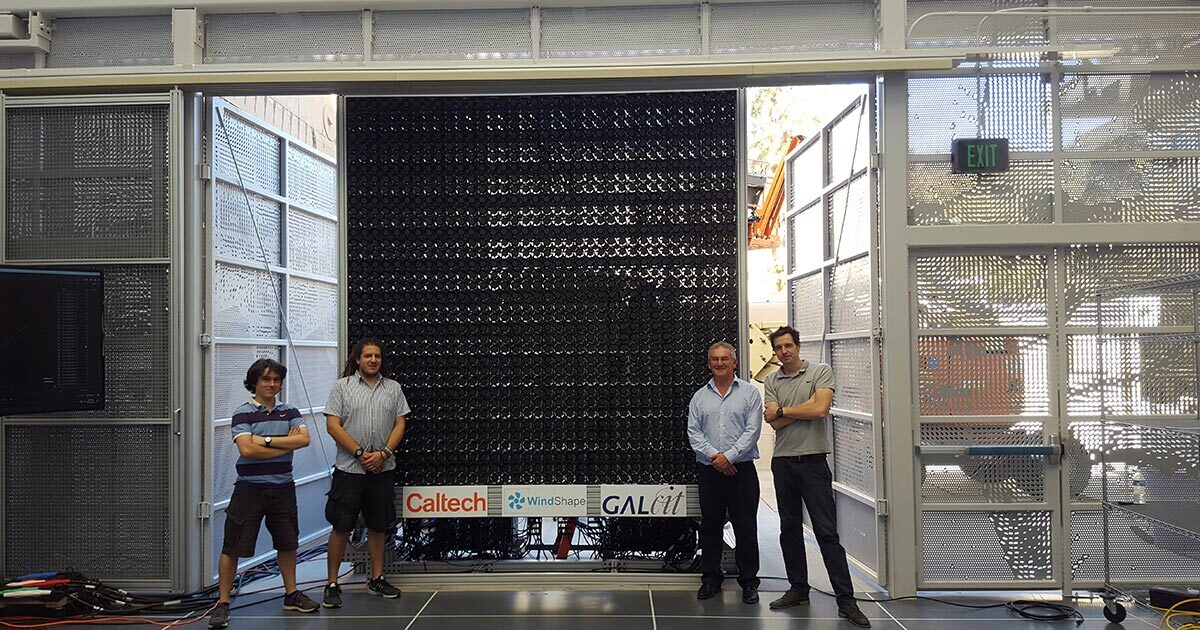
Flavio Noca is a professor of aerospace engineering at ÉTS, specializing in fluid mechanics and aeronautics. He is the holder or co-holder of several patents, inventor of a technology that contributed to the development of Ingenuity, the first helicopter on Mars, and co-founder of WindShape, a pioneering company in the manufacture of modular wind tunnels.
New department of Aerospace Engineering at ÉTS
In September 2025, fresh off the plane from Switzerland, Flavio Noca joined the faculty of the new Department of Aerospace Engineering at ÉTS. This program trains engineers to design aerospace vehicles and coordinate the final assembly of aircraft, engines, and spacecraft. “At ÉTS, I found the environment I enjoyed in Switzerland: people who know how to juggle practical and theoretical tools,” explains Professor Noca.
A nomadic childhood with African vibes
Originally from Italy but born in South Africa, Flavio Noca spent much of his childhood in the Democratic Republic of Congo. When Flavio turned four, American astronauts took their first steps on the moon, and Boeing launched its 747. These feats impressed young Flavio, who began drawing airplanes and rockets. This fascination has never left him. At 18, after graduating from the French high school René Descartes in Kinshasa, he flew to California, the birthplace of rockets and airplanes.
Flavio enrolled at Caltech (California Institute of Technology) in Pasadena, where so many Nobel Prize winners have left their mark. He earned a bachelor's degree in Engineering and Applied Sciences in 1988, followed by a master's degree in Aeronautics in 1989, and a PhD in the same discipline and at the same university in 1997.
After completing his university studies, Flavio Noca moved closer to his childhood dream: he joined NASA as an engineer and remained there for seven years. In 2005, he headed back to Switzerland for family reasons. Flavio accepted a position as a research professor for the Fluid Mechanics Laboratory at the Swiss Federal Institute of Technology in Lausanne. He then became associate professor of fluid mechanics and aerodynamics at HES-SO Geneva, where he headed the Hydro and Aero Center for nearly twenty years.

ÉTS Professor Flavio Noca
The one-of-a-kind wind tunnel in the world
For some time now, the engineer has been working on developing autonomous vehicles capable of flying just above the water surface. “Many rivers in Africa are not navigable because of sandbars, rapids, or other natural obstacles; this isolates populations,” explains Flavio Noca. These blue highways could be used to transport goods, medicines, and even people. The problem is that the smaller the vehicle, the more exposed it is to the elements, especially at low altitudes.
One day, while watching seagulls glide above the waves despite turbulent winds, Flavio came up with the idea of creating a wind tunnel to test flying machines. But not just any wind tunnel: a “pixelated” wind tunnel equipped with 1,300 miniature fans stacked and arranged in a honeycomb pattern. Since 2017, this device, first built at Caltech, has been able to simulate a variety of weather phenomena that could affect drones, producing realistic flight conditions to test their capabilities.
ÉTS, a productive incubator
Why teach when Flavio Noca could devote himself to research? Professor Noca was deeply impressed by the humanity of his professors and the longevity of their careers. As he wanted to follow in their footsteps, he enthusiastically agreed to participate in the training of the first class of Aerospace Engineering students at ÉTS.
However, this does not prevent the researcher from continuing his work on pixelated wind tunnels to make aerial vehicles safer. “We have the tool, the inventor, and now the students ready to accompany us on this daring adventure,” summarizes Flavio Noca. The seagull continues to inspire the creative little boy.