October 9, 2026
ÉTS recruited an internationally recognized theorist who redrew the map between classical and quantum computation, anchoring his research program—and the international community around it—in Montréal and Québec’s quantum ecosystem.
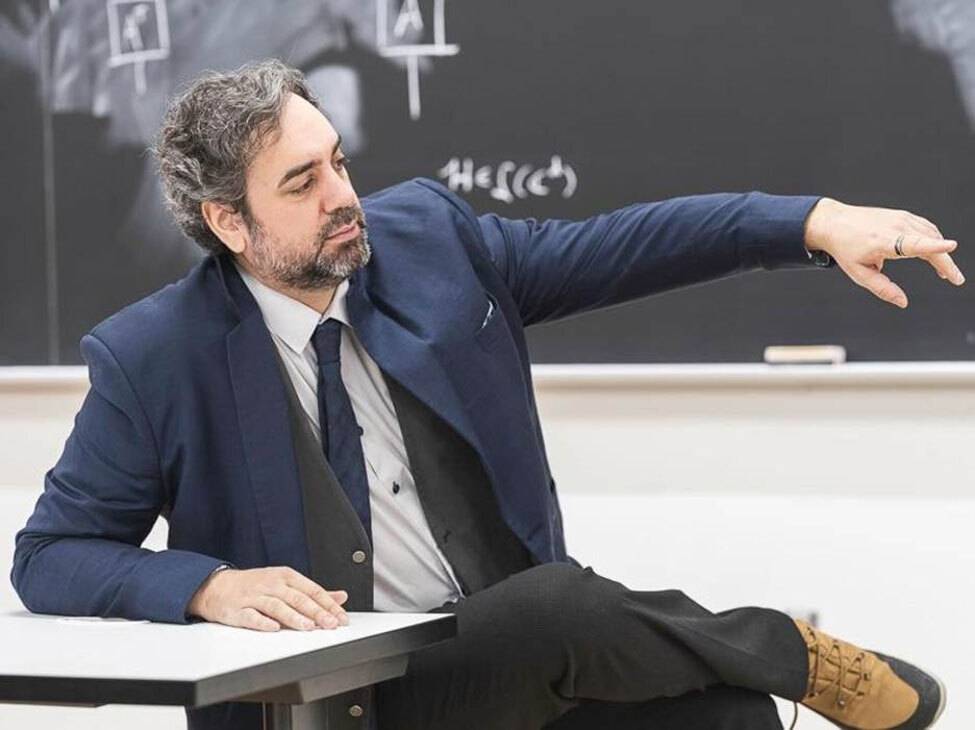
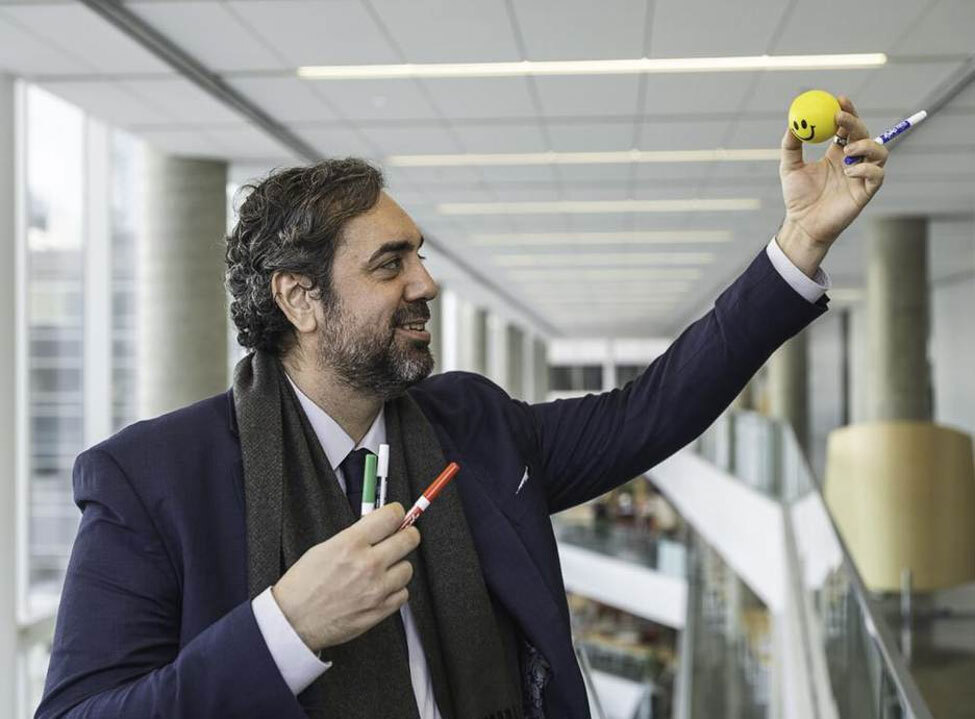
Biamonte at the blackboard in the Maison des étudiants. Photo: Vincent Lemelin / ÉTS Montréal.
When Biamonte began studying quantum computers, he pictured classical systems on one side and quantum machines on the other. “That’s just how it was explained at the time,” he recalls. “I wondered what structural changes were needed to move between the two.”
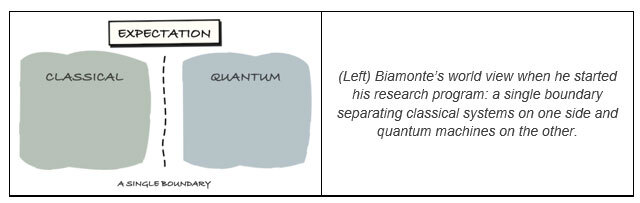
But the transition from classical to quantum is not across a single boundary. A quantum system can be difficult to simulate on a classical computer without being a universal quantum computer itself. Reproducing a system’s behaviour and programming it to perform a chosen computation are different challenges.
The key distinction, on Biamonte’s account, is programmability: the ability to compose interactions and constraints so that a physical system carries out a computation you choose. His research map distinguishes two edges—the limits of efficient classical simulation and the requirements for universal quantum computation—with a structured and still poorly understood territory between them. Biamonte calls this territory the classical–quantum terra incognita. Biamonte builds mathematical models at the edge of classical and quantum computation, revealing which features make a quantum system difficult to simulate and which enable universal quantum computation.
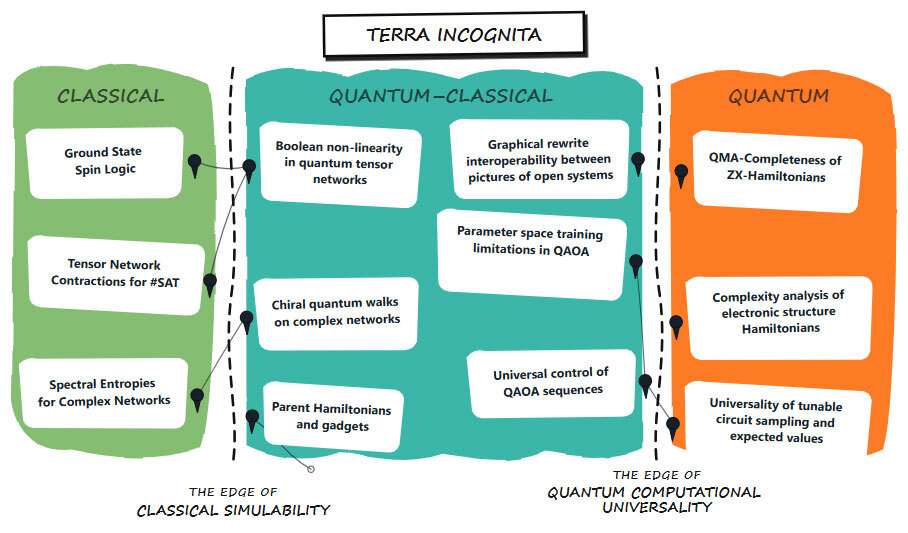
Conceptual diagram. The map distinguishes the limits of efficient classical simulation from the requirements for quantum computational universality. It brings together Biamonte’s work with his collaborators across these questions; the positions are schematic, not a complete classification of computational models
Explore the research behind the map.
The rise of the quantum industry has made understanding this intermediate territory a worldwide research challenge. Biamonte’s original contributions span universal quantum computation, tensor-network methods, simulation, optimization and machine learning, providing mathematical foundations for a new kind of engineering.
A map for a new kind of engineering
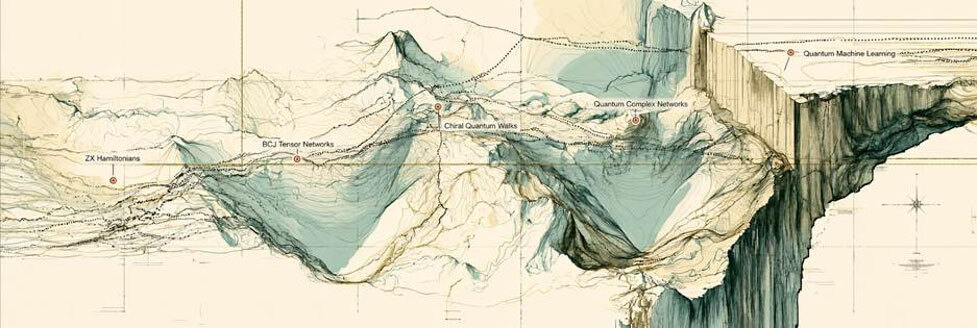
Conceptual illustration of research themes in Biamonte’s work with his collaborators. Image generated with Midjourney; labels added after generation.
The map Biamonte built is organized by a single question: when does a quantum system become a computer?
Early quantum applications

An early landmark came from his work with Peter Love. They showed how changing the interactions between qubits can change a system’s computational power, identifying simple interaction models sufficient for universal quantum computation. The result linked an abstract question about computation to concrete choices in quantum-machine design. Researchers have since used and extended these mathematical constructions in verification of quantum computation and molecular simulation, giving the work a life beyond its original hardware-design question.
A second line of research developed a language for quantum systems. With collaborators, Biamonte introduced algebraic building blocks for arbitrary quantum states and graphical methods for composing and transforming quantum processes. One diagram from the paper he co-authored with Christopher Wood and David Cory even reached a blackboard in Rick and Morty: a graphical treatment of the familiar “snake equation.”
A third line of work charts both possibilities and limits. Biamonte proved that variational quantum computation can, in principle, be universal: appropriately constructed circuits and objective functions can express any quantum computation. In separate work, his group identified what became widely known as reachability deficits in the quantum approximate optimization algorithm (QAOA), showing how the structure of a problem and the chosen circuit can prevent the algorithm from reaching the desired solution. Together, these results distinguish what a computational model can express from what a particular implementation can achieve.
“My work is carving out a language for a new kind of quantum engineering—for example, programming languages that control the low-energy states of quantum systems.” — Jacob Biamonte
A research program rooted in Montréal
When ÉTS recruited Jacob Biamonte in October 2024, it brought to Montréal a research program whose foundational results were already being used and extended internationally.
Biamonte is a full professor and holder of the MEIE Chair in Quantum Computing. He holds an Oxford DPhil in computer science and a Doctor of Science in mathematical physics. As co-founding director of the Institute for Quantum Science and Engineering, he connects this established research program with Québec’s quantum ecosystem.
The move also had personal resonance. His mother’s family, the Thibodeaus, came from French Canada and settled in Bangor, Maine. Montréal offered an opportunity to reconnect with those roots and learn French.
"Everything needed to lead quantum computing is already here in Québec: ecosystem expertise and world-class quantum hardware," he says.
The territory between the two edges remains only partly understood. For Biamonte, exploring it means finding which physical systems can be programmed, what they can compute and where useful quantum applications may emerge.
Québec has the quantum machines to go and look for them; Biamonte has the map.
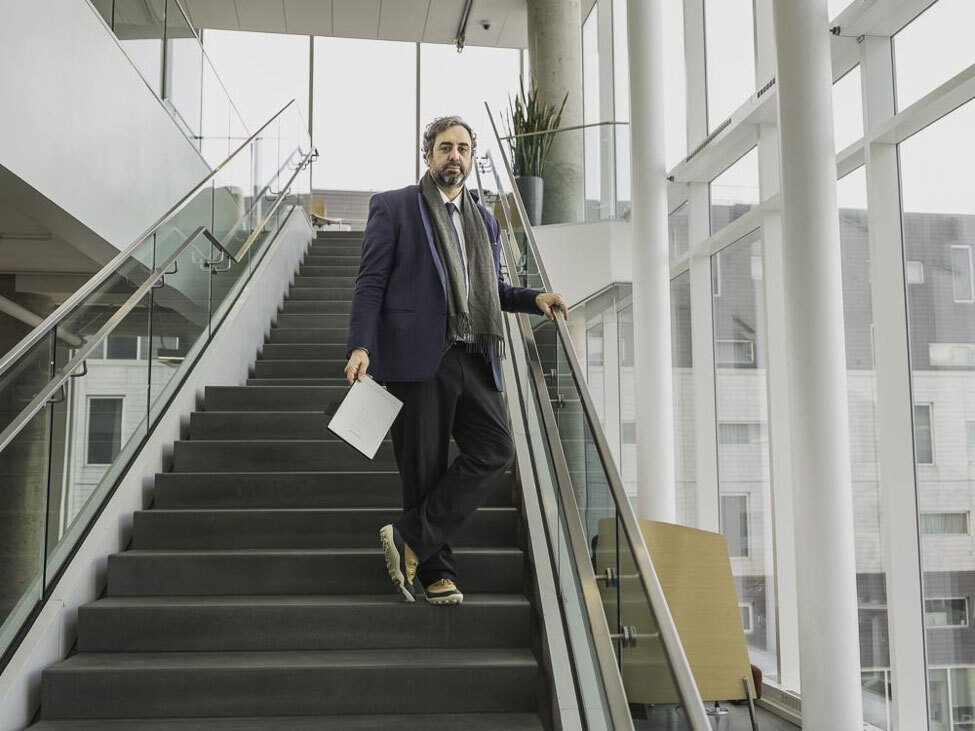
Biamonte at ÉTS Montréal. Photo: Vincent Lemelin / ÉTS Montréal.