September 15, 2026
A graduate of the PhD program in mechanical engineering from the École de technologie supérieure (ÉTS) and now a research and innovation advisor in medical technologies at TransMedTech, Gabrielle Cretot-Richert has built a career at the intersection of engineering, healthcare and applied research.
Deepening her expertise
Before embarking on her doctorate, Gabrielle already held two master’s degrees, including one in project management, and had been working in the advanced technology sector for several years. For five years, she worked at NUVÜ Cameras, a company specializing in ultra-sensitive cameras used primarily in aerospace and biomedicine. Housed at CENTECH, this tech startup introduced her to a cutting-edge innovation environment and highly specialized infrastructure.
Despite this experience in engineering and technology management, Gabrielle felt the need to deepen her technical expertise. When faced with complex R&D problems, she wanted to better understand the underlying scientific issues and directly contribute to solving them. This desire to develop more advanced expertise led her to pursue doctoral studies.
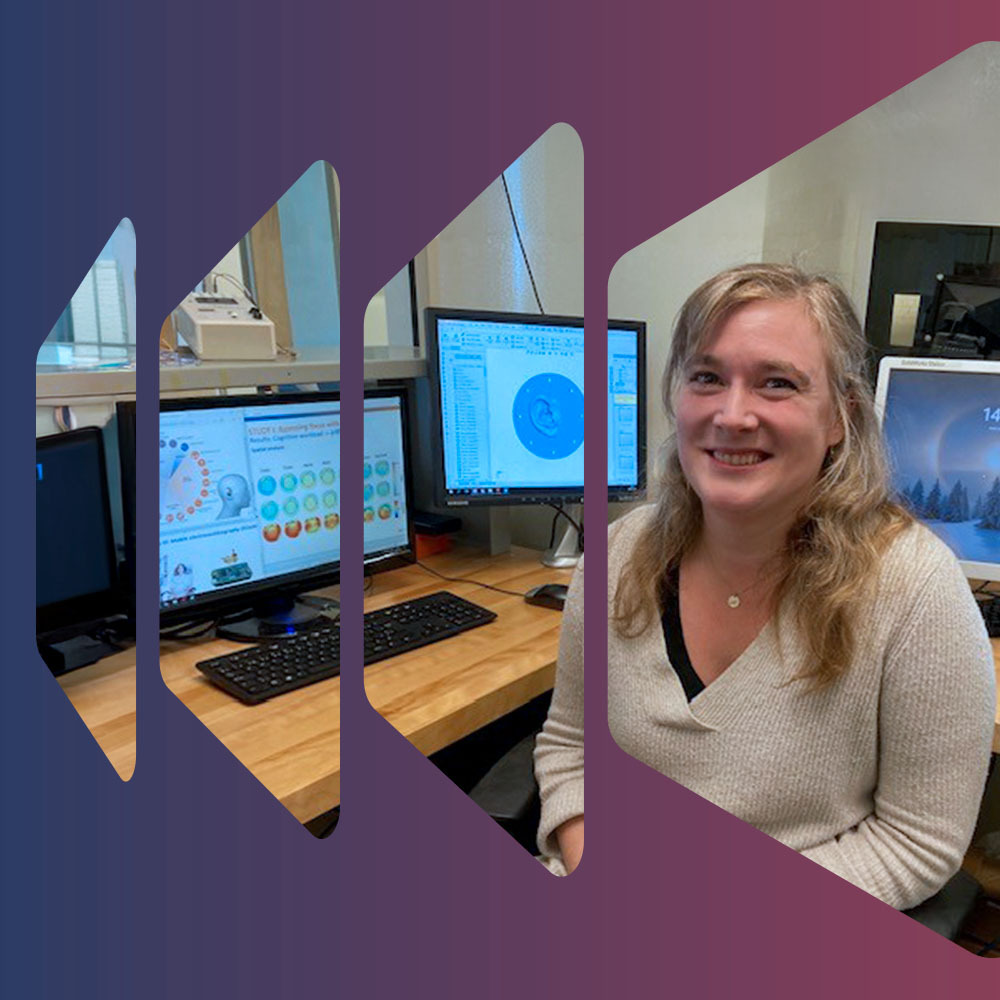
Gabrielle Cretot-Richert, PhD graduate in mechanical engineering from ÉTS
At the crossroads of engineering, healthcare and neuroscience
Her doctoral studies led her to join the EERS Research Chair directed by Jérémie Voix. Her research focused on medical instrumentation and in-ear devices, a field at the crossroads of mechanical engineering, biomedical technology and neuroscience.
Specifically, her research explored various physiological metrics that can be measured from the human ear. This topic led her to delve into fields such as neurophysiology, neurocognition and occupational hearing safety. Over the course of her PhD, she collaborated with neuroscientists, patients and multidisciplinary teams to conduct experiments related to measuring attention and cognitive focus.
International research experience
Her doctoral journey was also enriched by a year of studies in Germany, allowing her to expand her scientific collaboration network and gain international research experience.
Like many medical technology researchers, Gabrielle worked in environments that required strict methodological and ethical rigour. She collaborated with research ethics boards, participated in projects involving human subjects and managed complex experimental protocols for biomedical data collection and analysis.
Becoming the expert on her own research problem
She also highlights an important reality of doctoral studies: the solitary nature of research work. In many specialized projects, the PhD student often becomes the person who knows the subject best. While this responsibility can seem daunting, it also fosters unique expertise and strong professional autonomy.
For Gabrielle, a PhD allows her to do just that: become the expert on her own research problem. It offers the opportunity to work on cutting-edge scientific challenges, develop novel solutions and make a tangible impact in fields like healthcare and medical technology.
Studies that open up new horizons
Graduate studies also open up numerous career opportunities across the biomedical, hospital and health research sectors. In many organizations, strategic roles in innovation, research management or technology development require a master’s or a doctorate. These degrees also provide access to more structured R&D environments and long-term innovation projects.
Today, her role at TransMedTech allows her to contribute to the development and transfer of innovative medical technologies in collaboration with researchers, clinicians and industry partners.
Looking back, Gabrielle believes her PhD brought her far more than scientific expertise. The experience helped her build high-level autonomy, strong analytical skills and the confidence to tackle complex problems systematically and rigorously. For her, doctoral studies above all represent an opportunity to push intellectual boundaries and make a concrete contribution to health innovation.