November 11, 2026
How can electricity generated by wind turbines and solar panels be stored when demand is low, so it can be released when demand increases?
Carnot batteries offer a solution: convert electricity into heat, store it in a thermal storage tank, and then reconvert it back into electricity as needed. At ÉTS, research is under way at the Laboratory for Energy and Energy Efficiency (L3e) to define design methods, reduce costs, and assess the feasibility of these systems.
The challenge of renewable energy
Renewable energy generation and electricity demand do not always move at the same pace. For example, solar panels can generate a lot of electricity in the middle of the day, when demand is relatively low. Conversely, in the early evening, running heating and cooking appliances and other equipment simultaneously can spike electrical demand when solar generation drops. Wind power generation, meanwhile, varies with wind conditions, regardless of consumer needs. When generation exceeds demand, a surplus results; when it falls short, other sources must supply the missing electricity
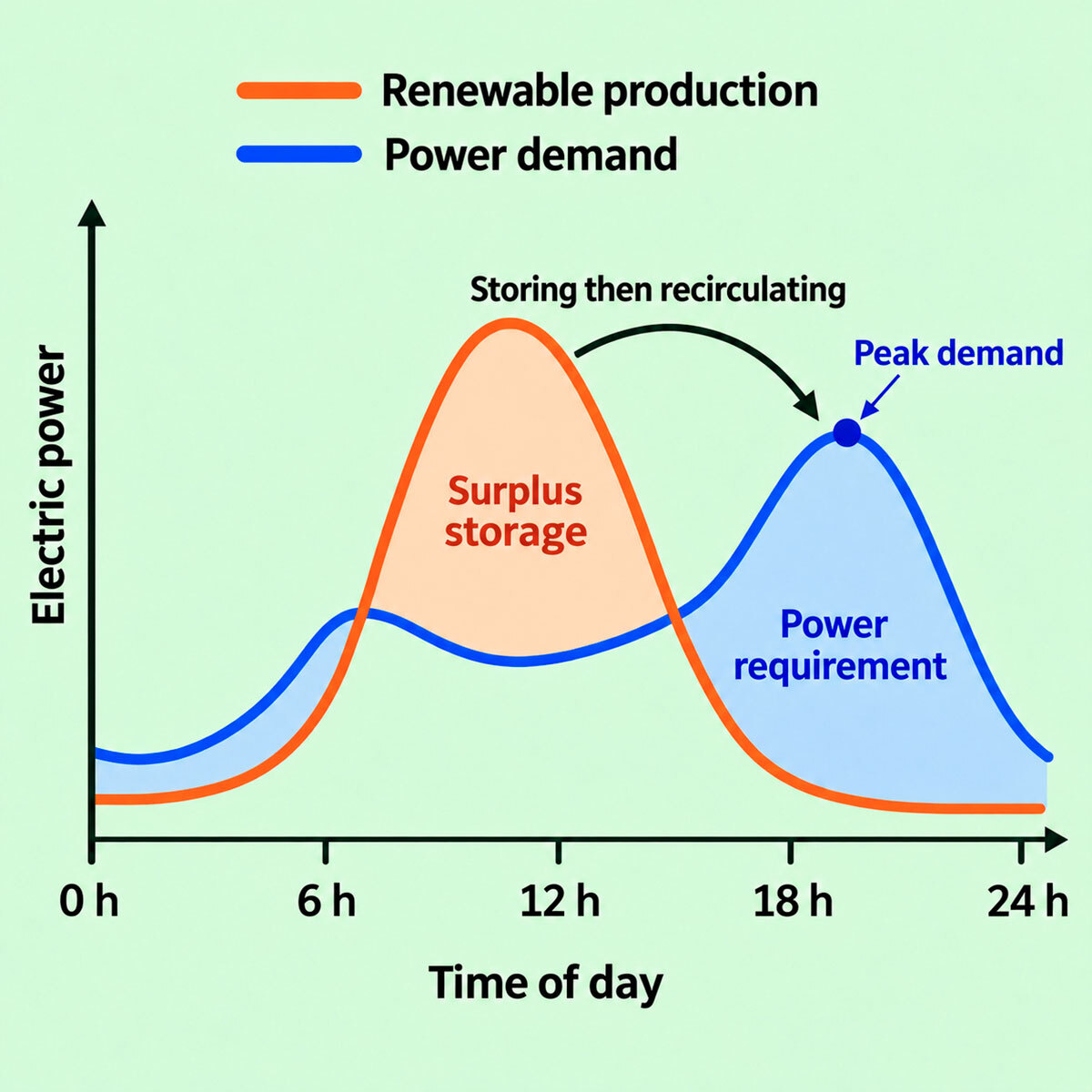
Storage bridges the gap between these two situations: it stores a portion of the surplus and releases it during periods of high demand or low production. This way, it helps maintain a balance between production and consumption.
Carnot batteries as a storage solution
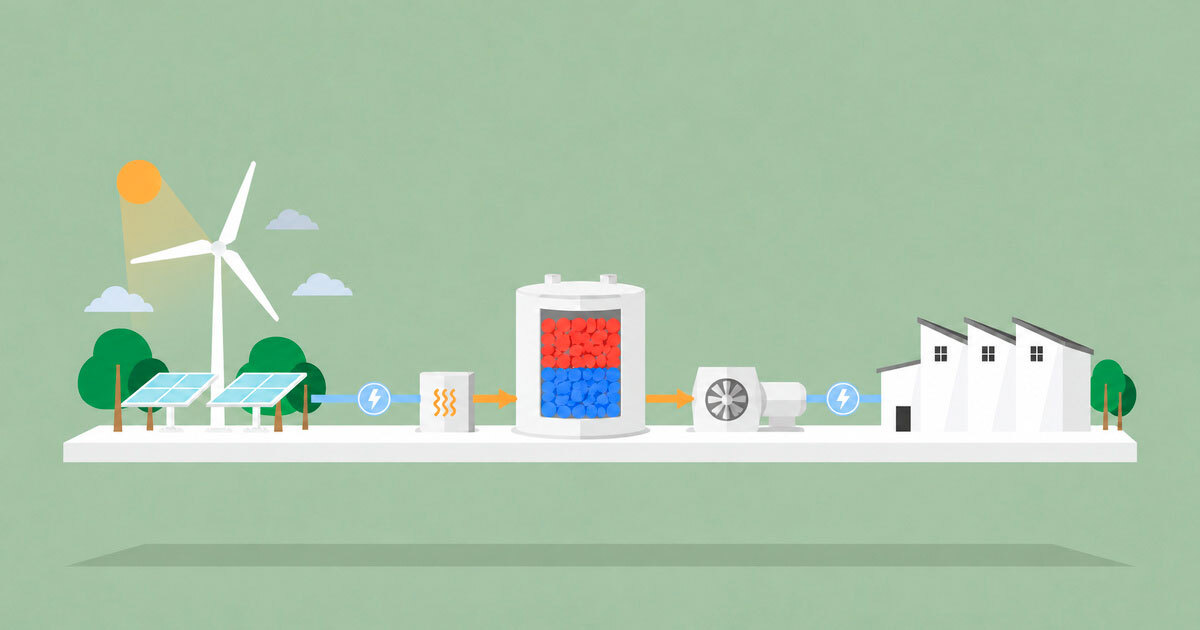
Carnot batteries store surplus electricity as heat. They operate in three stages (see the header image). First, electricity powers an electric heater or a heat pump. The generated heat is then carried to a reservoir through a heat-transfer fluid, or heat-carrying fluid, containing storage materials such as rock. Finally, when electricity is needed, the stored heat is fed into a power generation unit; this drives a turbine coupled to an alternator and generates electricity again. Depending on the configuration, some of the heat can also be used directly for heating or to power an industrial process.
Unlike electrochemical batteries, this technology can use abundant and inexpensive storage materials. It also has fewer geographical constraints than pumped-storage hydroelectricity, which requires reservoirs at different elevations. One of its main advantages is its ability to store large amounts of electricity. However, successive conversions result in losses: the amount of electricity recovered is generally lower than with an electrochemical battery. Consequently, the choice depends on the desired storage duration, costs, and electricity and heat requirements.
Designing a Carnot battery tailored to specific needs
A Carnot battery intended for a factory will not be designed the same way as one for an off-grid site. How much energy needs to be stored, and at what temperature? How quickly does the storage system need to be charged and discharged? The answers depend on production and demand.
These choices also affect the internal equipment. Changing the desired temperature or power output may require redesigning several components. This poses a challenge: comparing a large number of solutions requires calculations so complex that examining all possible solutions could take about a hundred years.
Doctoral research conducted at L3e is exploring this challenge. The goal is to determine whether a simplified model can help identify promising configurations before proceeding with detailed design. The idea is similar to a preliminary architectural sketch: it enables comparisons between multiple options before finalizing each architectural element. Here, the sketch describes the system’s heat transfer and rated power without delving into its internal workings.
Reducing the cost of Carnot batteries
In the conventional reservoir configuration (image below, on the left), the storage medium, such as rock, is submerged in a heat transfer fluid. Filling the spaces between the rocks requires a large volume of fluid, which can increase the system’s cost and environmental impact.
At L3e, another approach is being studied: spraying the fluid over the rocks (image on the right, right side). The fluid flows over the rocks to transfer or recover heat. It is then collected at the bottom of the reservoir and recirculated. The goal is to reduce fluid requirements without compromising heat transfer performance.
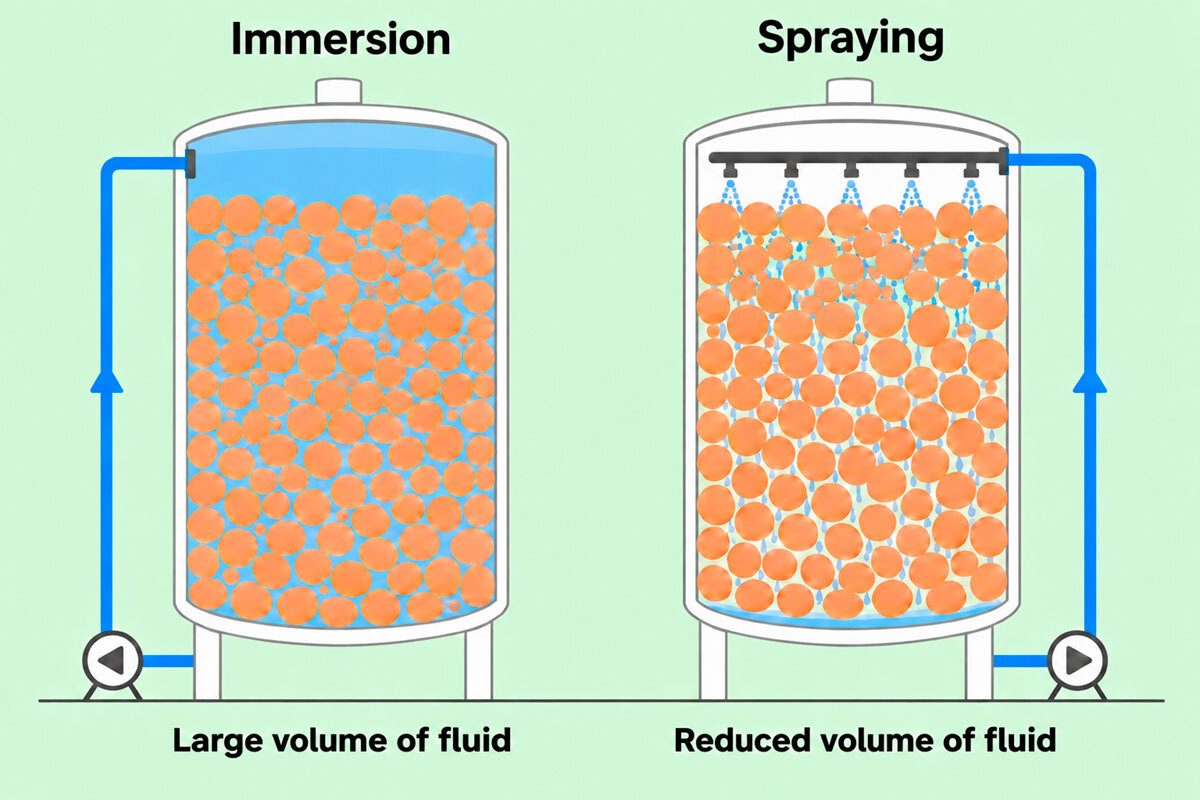
The principle is similar to the difference between a bath and a shower: a quick shower uses less water than filling a bathtub. Similarly, spraying ensures contact between the fluid and the rocks without completely submerging them.
Ways to improve thermal storage
Developing Carnot batteries is a balancing act between storage capacity, energy efficiency, and cost. By exploring simplified design methods and new thermal reservoir configurations, L3e’s research focuses on the conditions under which this technology could prove beneficial. Ultimately, these systems could help utilize surplus renewable electricity and meet energy needs when production is insufficient.
Additional information
For more information on this research, please refer to the following article: Sullivan Durand, Pierre Neveu, Daniel R. Rousse, Didier Haillot, Finite dimension thermodynamics-based preliminary design of multi-energy pumped thermal energy storage systems, Applied Thermal Engineering, Volume 289, Part 1, 2026, 129727, ISSN 1359-4311.