November 9, 2026
Surviving the extreme conditions of a Canadian winter
Globally, extreme temperatures claim 5.1 million lives each year, and cold is the overwhelming culprit. In fact, cold accounts for 8.5% of all deaths worldwide. This staggering reality is especially pressing in Canada. While a standard cold work environment is officially defined as any temperature below 10°C, typical Canadian winters plunge drastically below this mark. Imagine working an eight-hour shift outside in these conditions. For outdoor professionals, power-line technicians, construction workers, and mail carriers, sub-zero temperatures and biting winds pose severe occupational hazards. Prolonged exposure causes numbness and thermal stress, impairing physical and cognitive functions, ultimately compromising workplace safety and productivity.
The push for sustainable protection
To survive these conditions, workers need clothing that acts as a perfect shield. A high-performance winter coat must trap heat and block freezing winds, but it must also breathe. If sweat cannot escape, the resulting moisture rapidly drains body heat.
While the current market offers gear that meets these demanding criteria, one significant drawback remains: most garments rely heavily on petroleum-based synthetic fibres. As the demand for sustainable, environmentally friendly products grows, the textile industry must pivot away from non-renewable plastics. The goal is to develop super-insulating, high-performance winter clothing made from bio-sourced materials.
The hidden complexity of trapping heat
Designing eco-friendly textiles that can rival synthetics requires a precise understanding of how microscopic fibres trap heat. Traditionally, evaluating a fabric's warmth meant manufacturing dozens of physical swatches and testing them in a lab. This trial-and-error method is expensive and slow. More importantly, standard physical tests measure only final thermal resistance; they cannot reveal the invisible, complex ways heat moves through conduction, convection, and radiation, within the random arrangement of natural fibres. To truly optimize bio-sourced insulation, we need a way to look inside the fabric itself.
Building a virtual wind tunnel
Because physical testing cannot easily separate these microscopic heat-transfer mechanisms, this research takes a different approach: computational modelling. Using advanced computer simulations, researchers can essentially build a virtual wind tunnel. This digital environment isolates specific variables, revealing exactly how heat travels through the microscopic maze of a fabric and how external weather conditions interact with the garment.
The primary objective of this research was to build a highly accurate numerical tool that predicts how bio-sourced textile structures perform when battered by various wind speeds and directions. Bridging the gap between a jacket’s microscopic fibre properties and overall warmth, this tool provides a clear, physics-driven blueprint for designing superior winter gear.
Key findings
By breaking down the complex physical interactions happening inside the fabric, the simulations revealed several breakthroughs that challenge the traditional design of cold-weather protective clothing:
- Thinner fibres trap heat better: At the microscopic level, the geometry of individual fibres matters. The research showed that using natural, hollow fibres with smaller diameters actively curtails the amount of body heat lost through radiation.
- Thickness is not the answer: A common assumption is that a thicker coat is automatically a warmer coat. Simulations show this to be a highly inefficient strategy. While bulky layers offer protection in calm conditions, strong winds easily penetrate porous fabric, rapidly stripping away trapped heat through internal airflow.
- Air permeability is the true shield: As the figure 1 illustrates, aggressively lowering a fabric's permeability, rather than simply adding thicker layers, blocks wind penetration and increases its thermal resistance.
- Catching the "thermal lag": Traditional computer models assume that cold air blowing through a jacket instantly reaches the same temperature as the solid fabric fibres. However, this research revealed that in strong winds, air moves far too quickly for this temperature balance to occur. By upgrading the simulations to account for this "thermal lag," the new model corrected previous prediction errors, which exceeded 20%.
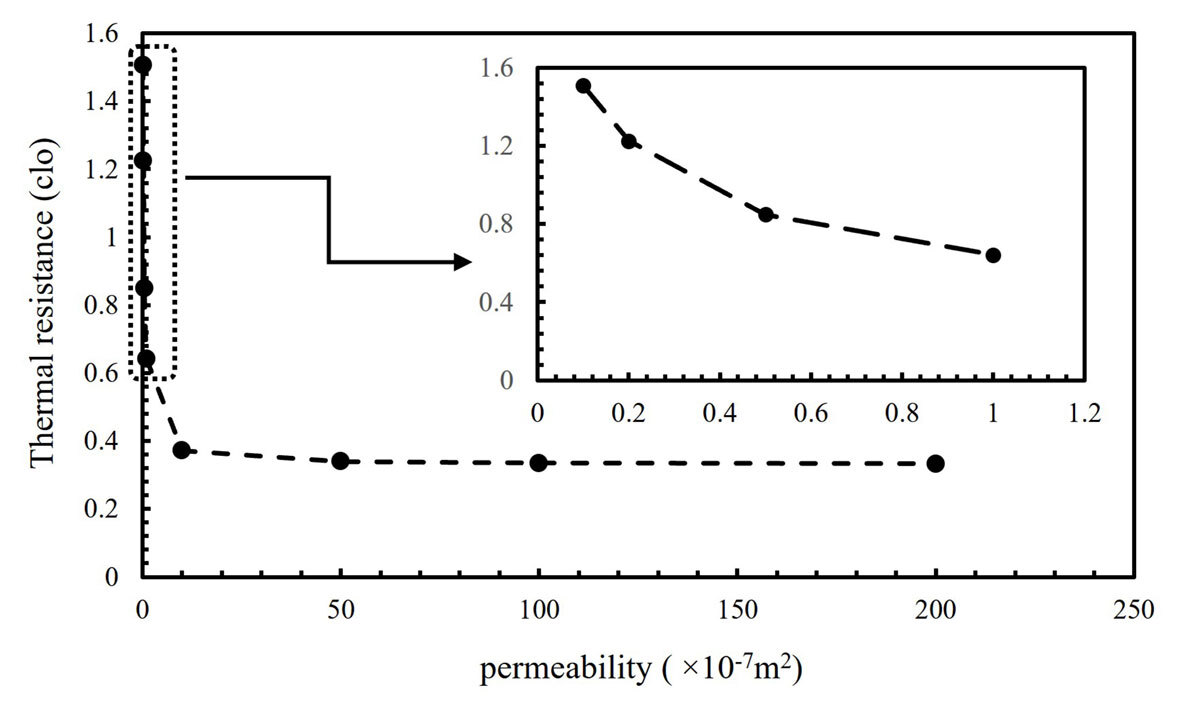
Figure 1: Variation of thermal resistance of the sample with air permeability under vertical wind velocity of 4 m/s.
Practical impact on occupational safety
Ultimately, this research shifts the design paradigm for winter clothing by showing that blocked internal airflow is more critical than fabric thickness and by providing a validated and accurate numerical tool to test these bio-sourced materials. Manufacturers can now engineer lighter, warmer, fully sustainable protective gear. For outdoor professionals enduring full shifts in freezing climates, this means safer working conditions, greater mobility, and reliable protection against the harshest elements.