
January 7, 2026
Summary
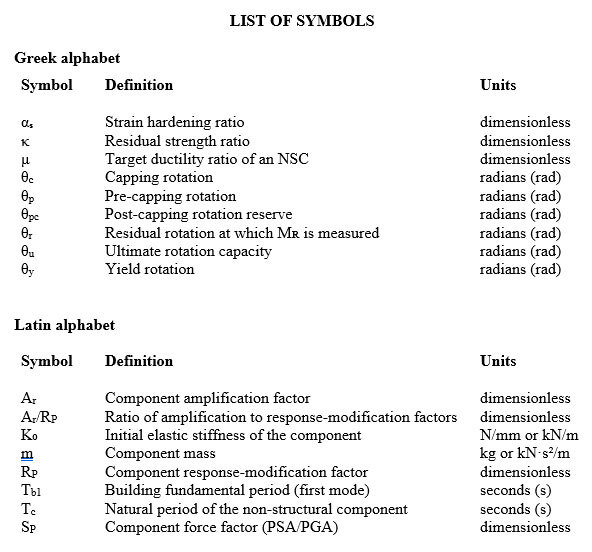
Over the past decades, many earthquakes, such as the 2020 Sparta, North Carolina earthquake (magnitude 5.1), have caused extensive damage to nonstructural components (NSCs), including suspended ceilings, HVAC chillers, and piping systems. These represent 70% to 85% of total building losses. While design codes have established seismic design requirements to protect NSCs from such damage, these requirements do not explicitly account for the combined actual nonlinear behavior of support structures and varying NSC attachment ductility levels under seismic conditions. Instead, codes rely on simplified response modification factors (RP) derived primarily from engineering judgment rather than comprehensive analytical validation. This research has made it possible to develop ductility-dependent peak component acceleration amplification factors (Ar/RP) through time-history analysis of reinforced concrete buildings subjected to earthquake records matched to Montreal's seismic hazards in Montreal. The study demonstrates that both component attachment ductility and structural nonlinearity substantially reduce seismic acceleration demands on NSCs, with practical implications for refining current code provisions and enabling more economical anchor design without compromising seismic safety.
Keywords: Non-structural components · Component attachment inelasticity · Ductility-based force modification factors · Incremental dynamic analysis · Structural nonlinearity · Seismic fragility
Nonstructural Components and Their Importance
Building elements that are not part of lateral load-resistance systems or gravity load-bearing elements are known as Nonstructural Components (NSCs) and are also known in Canada as Operational and Functional Components (OFCs). NSCs in buildings include architectural elements (exterior cladding, partition walls, ceilings), mechanical and electrical systems (HVAC equipment, chillers, boilers, transformers), plumbing and fire protection systems (piping, sprinklers), and building contents (furniture, equipment). Given that NSCs constitute 70% to 85% of total building replacement value (Taghavi & Miranda, 2003), their seismic failures result in substantial direct financial losses, business interruptions, and loss of building functionality.
Code Limitations and Research Motivation
Most standards, such as the National Building Code of Canada (NBC 2020), use component response modification factors (RP) to account for NSC attachment ductility and energy dissipation capacity. These factors range from 1.0 to 5.0, with the NBC specifying RP = 2.50 for suspended ceilings, RP = 1.25 for rigid machinery components, and RP = 2.50 for flexible machinery components. However, these values were derived primarily from engineering judgment rather than comprehensive analytical validation, and they remain constant regardless of the actual attachment ductility or the nonlinear response of the supporting structure during earthquakes (Anajafi, 2018; ATC, 2018; Villaverde, 2006; T. Wang et al., 2021).
Developing Ductility-Dependent Demand Factors
To address these limitations, we analyzed four moment-resisting reinforced concrete frame buildings with limited ductility (3-, 6-, 9-, and 12-story) and regular square plans. Each plan consisted of three 7-meter spans in each direction, designed by Mazloom (2023) in accordance with NBC 2015 and CSA-A-23.3-14 provisions. NSCs were modeled as single-degree-of-freedom systems with four specific attachment ductility levels: elastic attachments (μ = 1.0), low ductility (μ = 1.25), moderate ductility (μ = 1.5), and high ductility (μ = 2.0), attached to supporting structures at roof, intermediate, and ground floor elevations.
Using time-history analysis, this research develops ductility-dependent peak component acceleration amplification factors (Ar/RP), representing the ratio of component acceleration to floor acceleration across different ductility levels. Notably, we observed that acceleration demands decreased by 40% to 60% when component ductility increased from μ=1.0 to μ≈2.0 in the resonance period range. Figure 1 shows the Ar/RP factors equivalent to the ratio peak spectral acceleration (PSA) to peak floor acceleration (PFA) for various component ductility levels, demonstrating how increased ductility reduces spectral acceleration amplification.
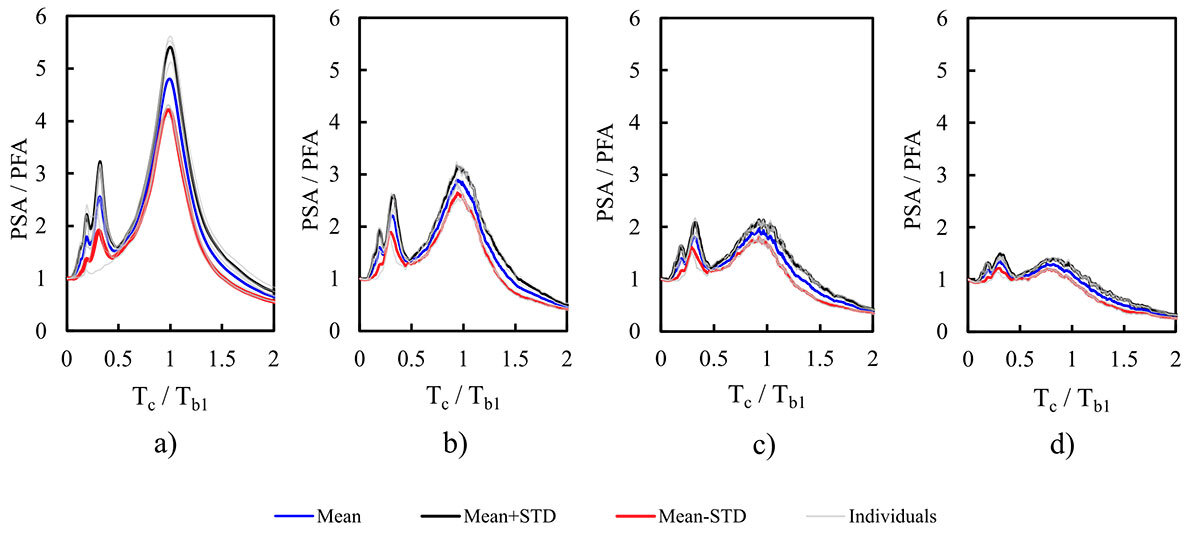
Figure 1-Ar/RP roof floor values of archetype buildings for various ductility levels: (a) μcomp=1, (b) μcomp=1.25, (c) μcomp=1.5, (d) μcomp=2
Incorporating Structural Nonlinearity Effects
As part of this ongoing research, structural nonlinearity was integrated by extracting pushover analysis results, with plastic hinges assigned at beam and column ends to capture realistic yielding behavior. In this part of the study, we calculated component force factors (SP = PSA/PGA) across various NSC attachment ductility levels, while accounting for structural nonlinearity to validate and refine current code formulations for NSC design.
To ensure robust validation, 12 detailed NSC models representing suspended ceiling and chiller systems were developed using the Ibarra-Medina-Krawinkler (IMK) model (Figure 2a). The model captures realistic hysteretic behavior, including strength degradation and stiffness deterioration. Each NSC model was represented by a cantilever spring system (Figure 2b) and mapped to specific FEMA P-58 components: unbraced suspended ceilings (M1), four-way diagonal wire-braced ceilings (M3), unrestrained vibration-isolated chillers (M2), and seismically restrained chillers (M4), with three parametric variations (a, b, c) per component type to cover different frequency ranges (1.0 Hz to 9.0 Hz) and ductility ranges (μ = 1.3 to 2.6).
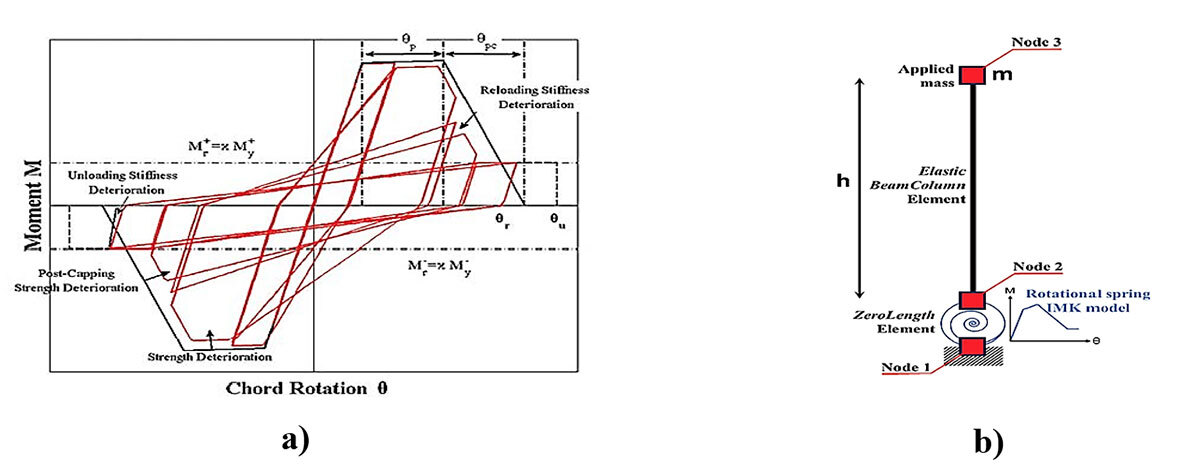
Figure 2 The numerical model includes: (a) the IMK hysteretic scheme, implemented in OpenSees, to capture cyclic behavior (Ibarra, 2004; Lignos & Krawinkler, 2013); (b) the cantilever NSC modeling scheme
This analysis revealed that structural nonlinearity provides additional acceleration demand reductions of 67% to 78% for elastic components and 9% to 64% for ductile components, compared to elastic structural assumptions. This demonstrates that current code approaches for elastic buildings significantly overestimate NSC seismic demands. The analyses identified μ≈1.5 (represented by the solid black curve in Figure 3) as the optimal ductility level, providing the greatest reduction in seismic acceleration demands (PSA/PGA ratios), while representing a practical and achievable level of inelasticity for common attachments. Figure 3 shows these results with validation points from the detailed models.
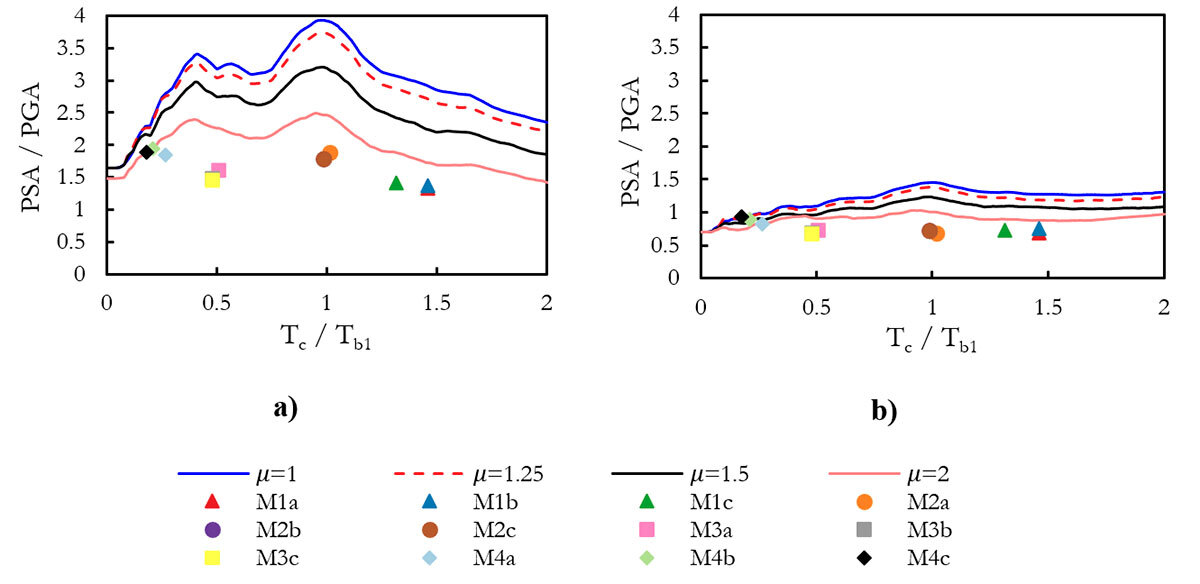
Figure 3 Mean PSA/PGA values of archetype buildings at two elevations: (a) roof, (b) intermediate; the markers represent the validation models (M1-M4) plotted against the proposed curves
Conclusion
This research demonstrates that increasing NSC attachment ductility from an elastic (μ=1.0) to a high-ductile state (μ≈2.0) can significantly reduce seismic acceleration demands by 40% to 60%, particularly in the critical resonance period range. The study revealed that accounting for the supporting structure's nonlinear behavior provides an additional demand reduction of 9% to 64% for ductile components and 67% to 78% for elastic components.
These findings validate the combined benefits of ductile attachments and accounting for structural nonlinearity, with an optimal performance identified at component ductility level of μ≈1.5, representing a practical balance between demand reduction and design feasibility. This finding directly challenges current NBC 2020 provisions, which specify constant RP values of 2.50 for suspended ceilings, 1.25 for rigid machinery components, and 2.50 for flexible machinery components, regardless of actual attachment ductility or structural nonlinearity. The calculated Ar/RP and SP factor results provide a basis for developing new, reliable ductility-dependent factors that explicitly account for both component ductility and structural nonlinearity, leading to more economical and safer NSC design.
Additional Information
For more information on this research and the references, please refer to the following research papers:
- Mehrjoo, M., & Assi, R. (2024). Proposed Reliable Peak Component Factors for Ductile Light NSCs Subjected to Horizontal Ground Motions. Bulletin of Earthquake Engineering. https://doi.org/10.1007/s10518-024-02081-x
- Mehrjoo, M., & Assi, R. (2025a). Probabilistic Assessment of Seismic Acceleration Demands of Ductile Light NSCs in Moderately Ductile RC Frame Buildings. Engineering Structures, 335, 120347. https://doi.org/10.1016/j.engstruct.2025.120347
- Mehrjoo, M., & Assi, R. (2026). Proposed Ductility-Based Force Factors for Acceleration-Sensitive Light Non-Structural Components. In Proceedings of the 6th International Workshop on Seismic Performance of Non-Structural Elements (SPONSE 2026). Suzukakedai Campus, Institute of Science Tokyo, Japan: International Association for the Seismic Performance of Non-Structural Elements (SPONSE).