
January 5, 2026

Abstract
Imagine driving while your electric car charges effortlessly, no plugs, no waiting. This is the concept behind Electric Road Systems (ERS), innovative infrastructures designed to power vehicles in motion. One promising approach, known as Dynamic Wireless Power Transfer (DWPT), uses inductive charging coils embedded in the pavement to deliver energy to receivers located beneath electric vehicles. This technology could accelerate the shift to electric mobility and enable heavy-duty vehicles, such as buses and trucks, to operate efficiently with smaller batteries, offering both financial and environmental benefits. Pavements in Canada are exposed to heavy traffic loads, frequent freeze–thaw cycles, and large temperature variations that may affect their durability. At ÉTS Montréal, we are conducting the first Canadian study to evaluate the structural performance of pavements incorporating this technology through laboratory testing, modeling, and full-scale experiments under Canada’s demanding traffic and climate conditions.
Keywords: Electric Road Systems (ERS); Dynamic Wireless Power Transfer; Inductive Charging Coils; Pavement performance; Sustainable Infrastructure
Introduction: Charging While Driving
Daily life increasingly depends on mobility, whether it’s commuting to work, delivering goods, or traveling long distances. Yet as more people look to electric vehicles (EVs) to cut emissions and energy costs, one challenge remains: charging. Stopping to plug in, waiting for the battery to refill, and planning trips around charging stations can make EV ownership less convenient than drivers expect.
Now imagine a road that solves this problem for you. As you drive, your car charges automatically, no stops, just seamless energy flow. This is the vision of Electric Road Systems (ERS), a new generation of smart infrastructure designed to power vehicles on the move.
Among Electric Road System (ERS) technologies, implemented in what are known as electrified roads (eRoads), Dynamic Wireless Power Transfer (DWPT) has attracted particular interest. Inductive eRoads operate through magnetic fields generated by coils embedded within the road surface—typically in the middle of the lane—which transfer energy wirelessly to a receiver mounted beneath the vehicle. Such systems have already been tested in several countries. Still, their performance under Canadian conditions, where pavements endure heavy truck loads, freezing temperatures, and frequent freeze–thaw cycles, remains largely unknown.
At ÉTS Montréal, in collaboration with Université Laval, we are conducting the first Canadian study to evaluate the performance of these inductive eRoad pavements under real traffic loading and local climate conditions. This study seeks to provide guidelines to incorporate ERS components into the pavement and to evaluate the mechanical behavior and durability of these roads.
The Challenge: When a New Component Meets Asphalt
Conventional asphalt pavements are built to provide mechanical strength and long-term durability, not to house electrical components. Introducing inductive coils into this structure is like adding a new organ to a body that was never designed for it. The coils, made of copper wires encased in a flexible polymer, create new “joints” within the asphalt where forces and temperature changes can concentrate. Over time, these stress points can lead to small cracks or separations in the same way that repetitive strain can injure a muscle or joint. To keep the pavement healthy and long-lasting, engineers must understand how these new components interact with the surrounding materials and design structures that can adapt without losing strength.
From Blueprint to Reality: Full-Scale Testing of eRoad Pavements
To understand how eRoads behave under real-world conditions, a full-scale experiment was carried out at Université Laval’s accelerated pavement testing facility. A Heavy Vehicle Simulator (HVS), a machine capable of applying thousands of controlled wheel passes, was used to mimic years of heavy traffic in just a few months.
Three pavement sections were built side by side: two inductive eRoads and one conventional control section for comparison. Each section was instrumented with strain gauges, load cells, thermistors, and moisture probes, allowing the team to track the pavement’s “heartbeat” in real time, measuring its response to changes in temperature, moisture, and load. Figure 1 shows several photos illustrating the main steps of the full-scale experiment.
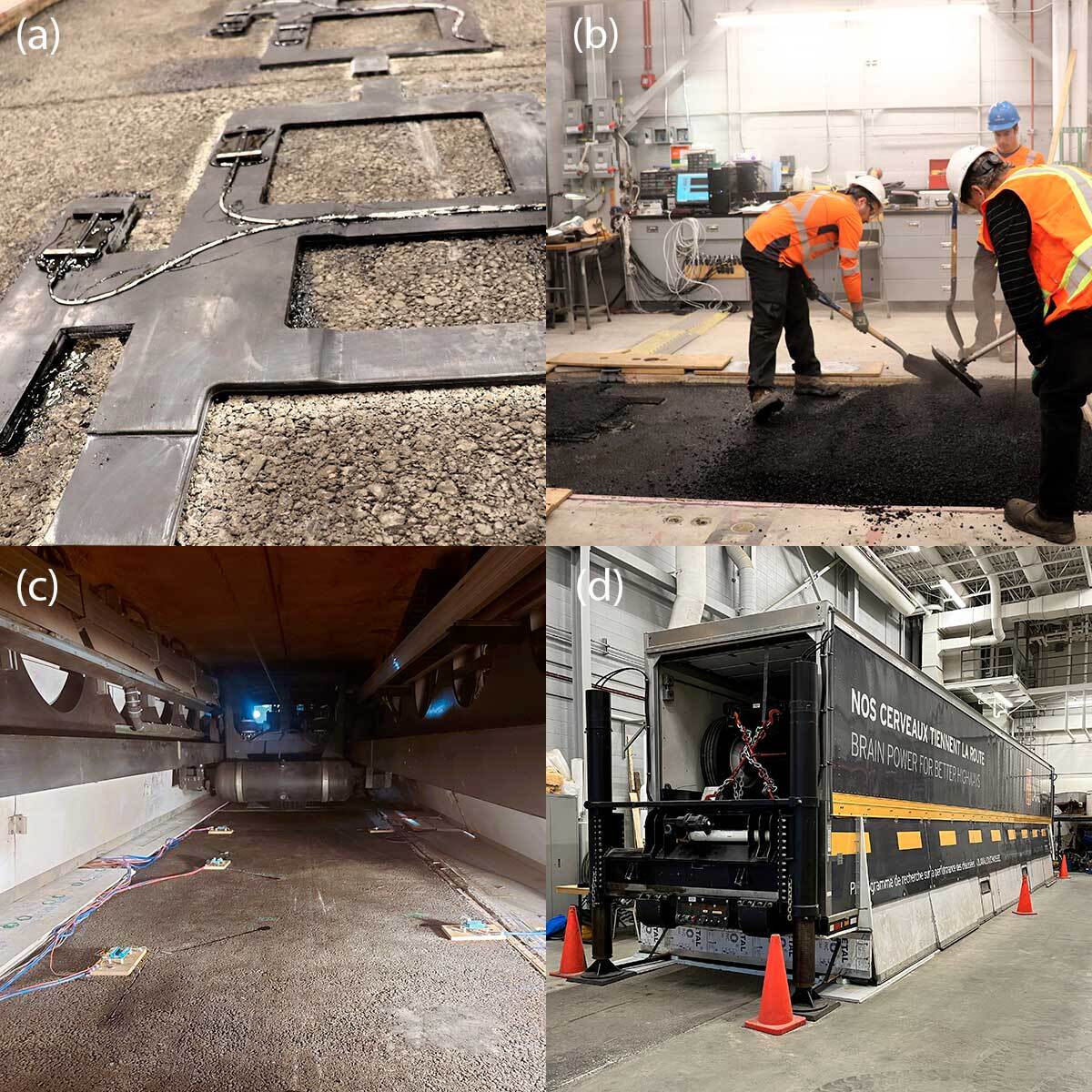
Figure 1. Full-scale testing of eRoad sections at the accelerated pavement testing facility; (a) installation of inductive charging coils and instrumentation; (b) placement of asphalt overlay; (c) instrumented test section under the HVS; (d) HVS applying repeated wheel loads to simulate heavy traffic loads and desired climate conditions.
Key Findings: Localized Effects, Global Stability Under Normal Traffic Conditions
Results confirm that when a wheel load passes directly over the coils, the pavement reacts like a muscle under pinpoint pressure, responsive but not harmed, showing a distinct mechanical response with increased local stress and strain near the coil–asphalt interface.
Under normal traffic conditions, however, where vehicle wheels rarely align directly above the coils, the pavement behaves much like a well-balanced structure, distributing loads evenly and maintaining overall stability. This behavior resembles that of the “body” that absorbs a bruise but keeps moving; the presence of the coils creates localized reactions, yet the pavement remains functional despite the added stress around them. This performance remained consistent even when the pavement was subjected to freeze–thaw and spring-thaw conditions, indicating that temperature and moisture variations did not alter the system’s structural response.
Real‑World Impact: Toward Sustainable Mobility in Cold Climates
These results bridge the gap between advanced materials research and sustainable mobility. Our study represents the first evaluation of this technology under Canadian conditions, providing essential knowledge for future large-scale demonstrators on real roads. As the technology matures, such initiatives could help communities strengthen the electric vehicle ecosystem, and contribute to Canada’s broader transition to cleaner, smarter mobility.
Key References:
Arzjani, Danial, Carret, J.-C., Bilodeau, J.-P., & Cardona, D. R. (2025). Evaluating the structural performance of eRoad pavements: impact of inductive charging coils on mechanical behavior. Road Materials and Pavement Design, 26(sup1), 55‑71. https://doi.org/10.1080/14680629.2025.2492142
Arzjani, D, Carret, J.-C., Bilodeau, J.-P., & Ramirez Cardona, D. (2025). Characterization of the mechanical response of Electric Road Pavement Structures in Heavy Vehicle Simulator Tests. Communication présentée au HVTT18: Trucking toward S2MART transport, Québec City, Québec, Canada. Repéré à https://applications.fsa.ulaval.ca/cfp/public/article.aspx?id=859
Arzjani, Danial, Carret, J.-C., Bilodeau, J.-P., Griggio, A., Proteau, M., Koren, I., & Ramirez Cardona, D. (2024). Laboratory Study on an eRoad Pavement Structure Utilizing Accelerated Loading Tests, (Département de génie de la construction, École de technologie supérieure).
Arzjani, Danial, Ramirez Cardona, D., Carret, J.-C., Bilodeau, J.-P., & Auger, S. (2024). Instrumentation of a Pavement Structure Containing Inductive Charging Equipment in the Canadian Context. Dans Proceedings of the Canadian Society for Civil Engineering Annual Conference 2023, Volume 7 (pp. 1‑14). Cham : Springer Nature Switzerland. https://doi.org/10.1007/978-3-031-61511-5_1
ICI Radio-Canada. (2023, Novembre 1). Alléger l’empreinte des poids lourds. https://ici.radio-canada.ca/carbone/reportage/document/nouvelles/article/2022815/camion-poids-lourds-pollution-transport-environnement-carbone