September 24, 2026
A PhD graduate and currently an AI specialist at Robotiq, Jennifer Kwiatkowski demonstrates how graduate studies can serve as a powerful driver of specialization, innovation, and career advancement in cutting-edge tech sectors such as AI and robotics.
In highly technical fields, developing deep expertise is essential. Graduate studies, particularly at the doctoral level, allow individuals to acquire advanced knowledge, master complex technologies, and specialize in a specific field of applied research. For Jennifer, this expertise is now a major asset in the professional world, where skills in artificial intelligence, industrial robotics and R&D are in particularly high demand.
Developing transferable expertise for industry
In the tech industry, a PhD represents far more than an academic degree. It demonstrates the ability to independently lead a complex research project, solve technical problems, and design innovative solutions. The dissertation thus serves as tangible proof of competence in technological innovation and product development.
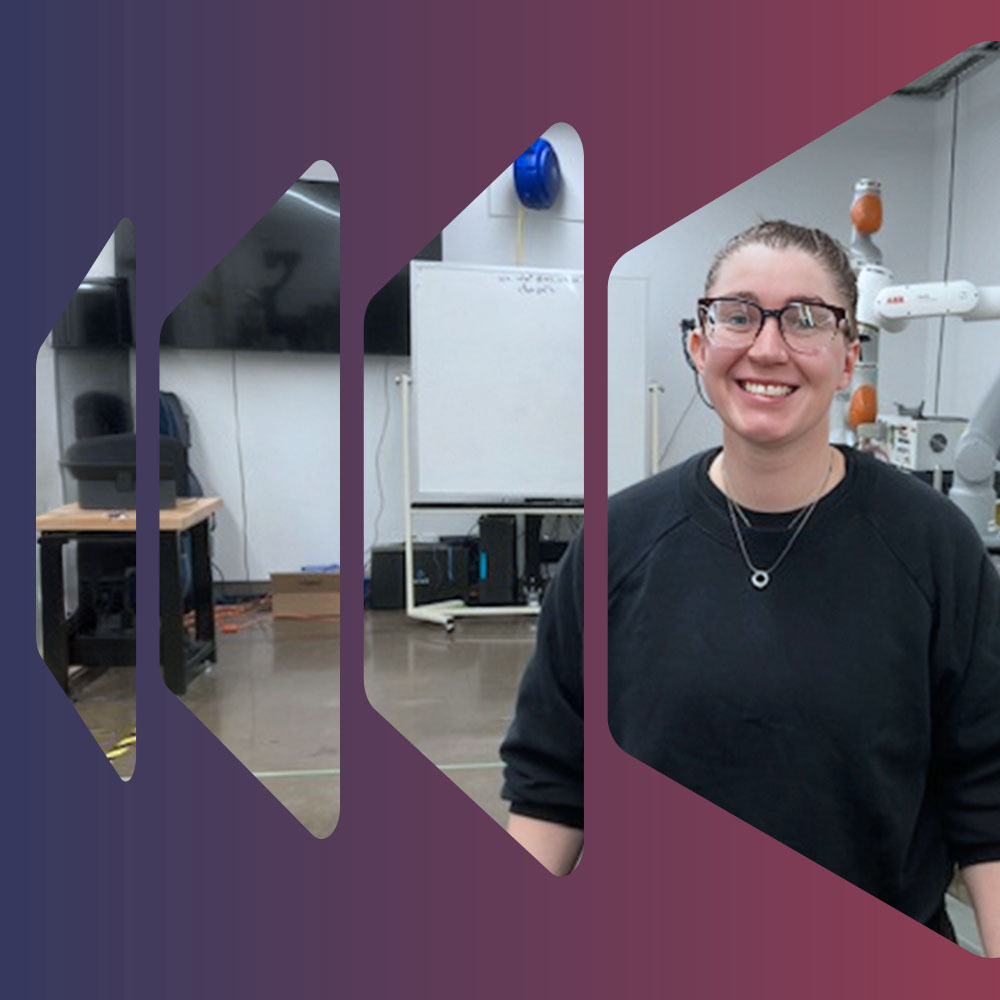
Jennifer Kwiatkowski, PhD graduate from ÉTS
Throughout her doctoral journey, Jennifer developed a rigorous work methodology: identifying a problem, analyzing existing knowledge, designing approaches, testing hypotheses, and interpreting results. This capacity for analysis and structured thinking is vital in artificial intelligence and robotics today, where technological challenges evolve rapidly.
Learning to manage complex projects
Doctoral studies also allowed her to gain solid experience in complex project management. In many tech companies, reaching technical leadership positions can require many years of experience. A PhD can accelerate this career path by demonstrating strong autonomy, high-level analytical capabilities, and advanced expertise in research and development.
Expertise built over time
In sectors like industrial robotics and artificial intelligence, keeping up with technological advancements is essential. Jennifer emphasizes the importance of staying current by reading scientific literature, attending specialized training and conferences, and following technical content to understand new approaches and emerging technologies. This capacity for continuous learning is at the heart of careers in technological innovation.
Her journey also illustrates the reality of research work. Every project begins by identifying a concrete problem, followed by a review of scientific literature and the development of necessary tools: programming, sensors, robotics, modelling or training AI models. This is followed by weeks, sometimes months, of experimentation, data analysis and validation before publishing scientific results.
In academic research as in industry, each discovery often leads to new questions. This gradual progression requires as much perseverance as humility. Over the years, Jennifer developed specialized expertise, notably in computer vision and robotic manipulation, two rapidly growing fields in the automation and AI industries.
From research to product development
Today, working at an innovative company like Robotiq allows her to actively participate in bringing research into industry. She can see how a technological innovation becomes a commercially viable product on a large scale and gain an understanding of complementary aspects of innovation, such as strategy, marketing and market development.
Before starting her doctorate, Jennifer worked in the aerospace sector. However, she wanted to work in an environment where technology evolves rapidly and where innovation takes centre stage. Although programming was not initially one of her main strengths, she progressively built her skills through practice, continuous learning and perseverance.
Curiosity as a driving force
Ultimately, her decision to pursue doctoral studies stems from a deep intellectual curiosity, along with a constant drive to learn, understand and contribute to the development of technologies that can transform the world.