September 11, 2026
How can we track astronauts’ cognitive load, stress and fatigue during training and space exploration missions? This is the challenge Professor David St-Onge and his team are tackling, supported by a $290,205 grant from the Canadian Space Agency.
An interdisciplinary project for space exploration
Titled “Evidence-based training and remote cognition monitoring on space exploration missions,” the project aims to develop an integrated platform to monitor the cognitive and physiological state of individuals performing complex tasks in real time. The solution is primarily designed for astronaut training, the supervision of analogue missions and, more broadly, environments where human performance must be maintained under extreme conditions.
The project brings together expertise in engineering, robotics, and multimodal artificial intelligence from the École de technologie supérieure (ÉTS), cognitive neuroscience from Concordia University and workload-monitoring training interfaces from KEPLR Intelligence. Key team members include Akhil Pilakkatt Meethal, research associate at ÉTS and AI engineer at KEPLR Intelligence; Ahmad Pour Adabi, PhD candidate at ÉTS; and Professor Emily Coffey from Concordia University’s Department of Psychology.
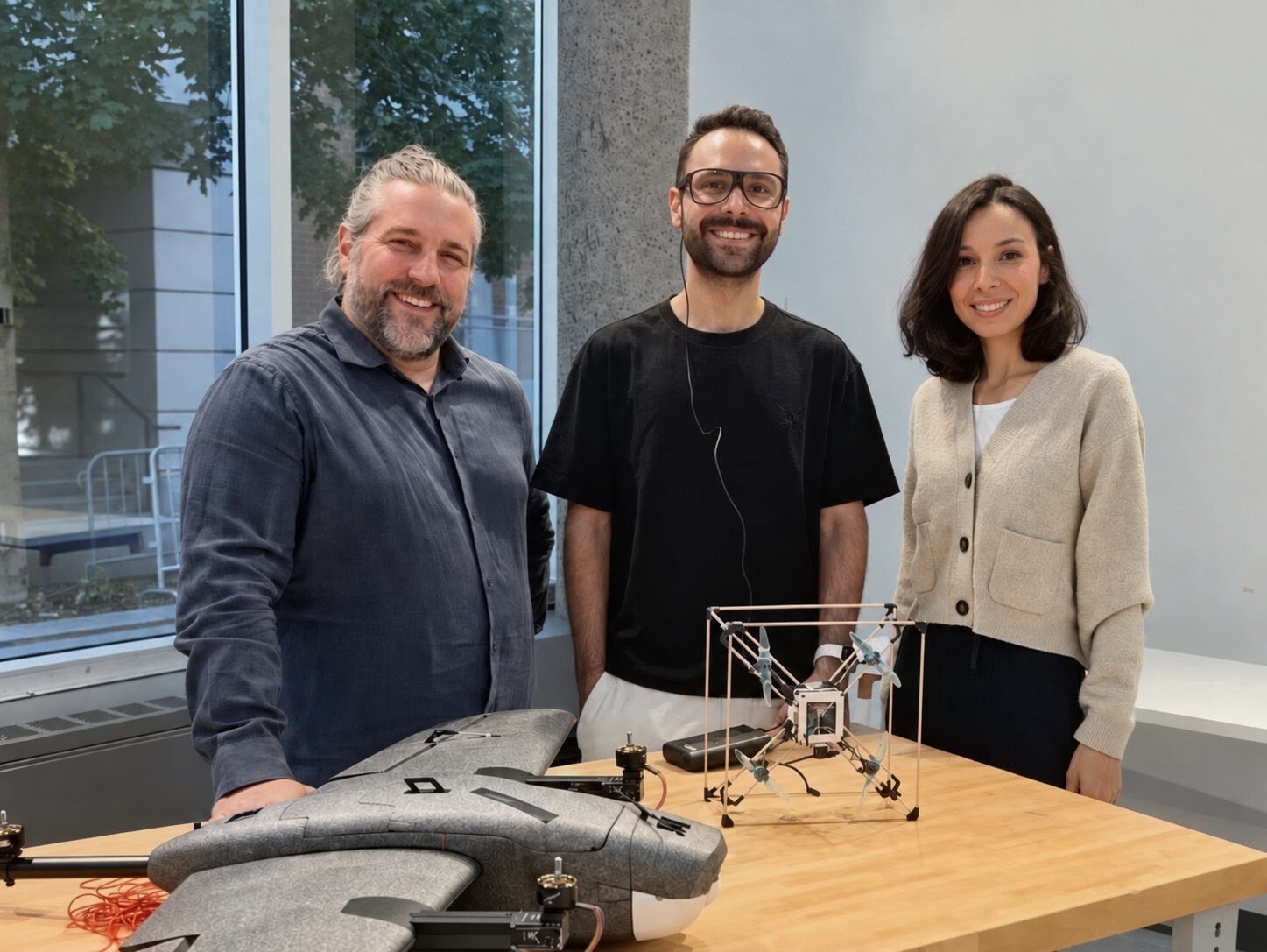
From left to right: David St-Onge, professor in the Department of Mechanical Engineering; Ahmad Pour Adabi, PhD student at ÉTS, wearing eye-tracking glasses; and Selwa Rafi, founder of KEPLR Intelligence.
Understanding cognitive state under real-world conditions
The platform will rely on a variety of synchronized wearable sensors measuring various metrics, such as heart rate, eye movements, body movement and brainwaves. The collected data will be used to continuously classify several states that can impact complex task execution, including cognitive load, stress, fatigue and situational awareness.
One of the main scientific challenges lies in making these measurements reliable outside controlled laboratory environments. Physiological and eye-tracking signals are highly sensitive to individual differences, physical movement, exertion and changing lighting conditions. These are the exact types of interference encountered during analogue missions, mechatronic or telerobotic operations and exploration environments.
To address this, the project will focus on developing artificial intelligence models capable of isolating genuine variations in cognitive state from environmental noise. The team will also need to synchronize heterogeneous data streams, ensure real-time inference, manage signal loss or degradation and produce clear, actionable indicators to support decision-making.
Two complementary dashboards
The indicators generated by the platform will feed into two distinct dashboards:
- The first will deliver immediate feedback to astronauts or operators in training, supporting data-driven learning.
- The second will enable remote supervision teams, such as ground control, to monitor real-time condition trends, adjust task assignments and better manage risk.
This focus on interpretability is central to the project. The goal is not merely to classify signals, but to convert complex physiological data into clear, actionable insights that can be readily used by trainees, instructors and mission teams alike.
Progressive validation
The solution will rely on robust models developed at ÉTS using existing databases, which will then be refined and validated across three experimental campaigns:
- The first, held at ÉTS, will focus on the simulated supervision of a robot fleet.
- The second will take place at the Canadian Space Agency’s analogue site in Saint-Hubert, under outdoor conditions reflecting key constraints of spatial teleoperation.
- The third campaign, conducted in partnership with Spéléo Québec, will assess the platform’s feasibility in a harsh underground environment.
These trials will primarily serve to test the approach’s robustness: maintaining data quality, sensor ergonomics, real-time model reliability, dashboard usability and the system’s overall capacity to perform when conditions become less predictable.
Tools for human performance on missions
The project’s novelty lies in shifting physiological monitoring from purely medical applications or controlled cockpits to field-deployable solutions. The platform will need to deliver robust, interpretable results despite movement, physical exertion, lighting variations and individual baseline differences.
Ultimately, this work could support behavioural health, human performance and operational autonomy during space missions. It will also help train highly qualified personnel in strategic fields such as multimodal AI, human factors, robotics, interface design and technology validation in extreme environments.