August 13, 2026
Artificial intelligence is often associated with increasingly powerful models capable of processing vast amounts of data. For ÉTS Professor Mohamed Cheriet, however, the real challenge is not simply to develop more powerful algorithms, but to make them intelligent enough to solve complex problems while using resources responsibly. Whether it is unlocking centuries of knowledge hidden in ancient documents or reducing the environmental footprint of digital technologies, a common thread runs through his work: using artificial intelligence to make complexity easier to manage while designing tools, infrastructure, and solutions that help others go further.
Breathing new life into documents
Mohamed Cheriet’s early research focused on pattern recognition and document image analysis. His team developed methods that enabled computers to interpret images, text, and, above all, handwriting.
This field is far from straightforward. Handwriting varies from one person to another, from one era to another, and from one language to another. Ancient documents are often damaged, incomplete, or difficult to read. Automatically extracting their content is therefore a major scientific challenge so much so that handwriting recognition remains one of the longstanding challenges in artificial intelligence.
Today, this research has taken on an entirely new dimension. It is no longer simply about deciphering a single document, but of understanding entire collections that may contain millions of documents. The goal is to make these vast corpora searchable so that researchers can quickly find answers, identify connections, or uncover previously hidden connections.
This approach, known as document intelligence, combines document digitization, automated information extraction, machine learning, and intelligent ways of organizing information. It makes it possible to connect information from a wide variety of sources in order to answer complex questions.
As digital humanities have increasingly embraced artificial intelligence, this expertise has become a natural bridge between engineering and the humanities. Anthropologists, historians, and philosophers can now explore vast document collections using AI-powered tools. Mohamed Cheriet likes to say that his algorithms act as “glasses” for researchers, allowing them to see what would be virtually impossible to discover manually.
Beyond supporting research, these technologies also help preserve our documentary heritage by making historical archives more accessible to both researchers and the general public. By making these collections searchable, they open new ways of exploring our shared history and uncovering discoveries that might otherwise have remained hidden.
Although the areas of application may differ, the underlying approach remains the same: designing systems that manage complexity while making more effective use of available resources.
More environmentally friendly information technologies
Since the early 2000s, Mohamed Cheriet has been developing a second major research focus in telecommunications and digital infrastructure.
Originally, the work was intended to address a very specific need: enabling telepresence and remote operation of research equipment. The research quickly expanded to include computing resources virtualization, and then cloud infrastructure.
This evolution led to the creation of the Tier 1 Canada Research Chair in Smart Sustainable Eco-Cloud and to a research focus that continues to guide his work today: how can information technologies be made more environmentally sustainable?
Data centers consume large amounts of energy. Rather than transporting electricity to data centers, Mohamed Cheriet and his team propose moving computing tasks to locations where renewable energy is available. This vision has become a reality with GreenStar Network, one of the world’s first research optical networks powered by renewable energy. Funded by CANARIE, this project is based on a federation of cloud computing infrastructures that intelligently distributes processing tasks across multiple data centers according to the “follow the sun, follow the wind” principle to reduce their carbon footprint. This approach has since been expanded through industry partnerships, especially with Ericsson, to improve the energy efficiency of data centers that host mobile applications.
Beyond scientific advances, these projects have helped build research platforms and strengthen long-term collaborations between academia and industry.
More recently, as part of the Alliance/INNOVÉÉ project conducted in collaboration with Ericsson, his team developed AI-based solutions to optimize the energy consumption of 5G networks. This work demonstrates that network performance and energy efficiency can be improved simultaneously.
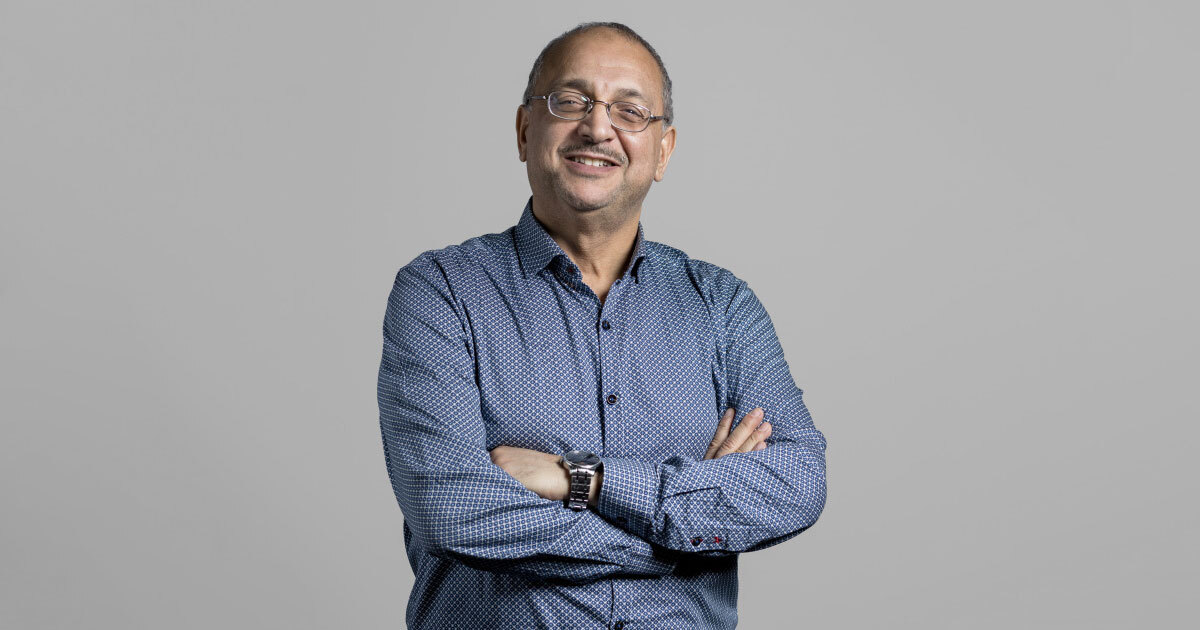
ÉTS Professor Mohamed Cheriet
Reducing complexity without wasting energy
At first glance, the analysis of ancient documents and telecommunications networks seems to belong to two completely different worlds. Yet Mohamed Cheriet sees a common challenge in both: how can information be organized and resources used more efficiently to manage complexity?
For documents, this collective intelligence involves linking knowledge from multiple sources to build knowledge structures that can answer complex questions.
For networks, it enables digital infrastructures to share their resources, learn from their environment, and operate more autonomously.
In both situations, artificial intelligence acts as a catalyst, transforming scattered information into knowledge, while enabling others to solve increasingly complex problems.
But this intelligence comes at a cost. The most advanced AI models require considerable computing power and consume a great deal of energy. For Mohamed Cheriet, simply developing ever-larger models is not enough; it is also necessary to choose the right level of complexity based on the problem at hand.
“You don’t use a sledgehammer to kill a fly,” he says.
This quest for balance is part of the concept of digital sobriety: designing effective solutions while limiting their consumption of computing resources and energy.
A distributed factory powered by cloud computing and 5G
This vision is now becoming reality throughan ambitious cloud-based manufacturing testbed funded by the Canada Foundation for Innovation.
The project brings together six universities and two CEGEPs, pooling manufacturing equipment spread across multiple sites. At ÉTS, for example, industrial robots are part of this shared infrastructure. Each institution has different equipment, but all are connected to the same cloud environment.
Thanks to 5G and artificial intelligence, machines can communicate with one another with very low latency. A central control room handles task allocation, operational coordination, and real-time monitoring across all participating sites.
This approach paves the way for distributed manufacturing, allowing multiple factories to collaborate as though they were part of a single production line. For example, an automaker with multiple manufacturing sites could share its resources and coordinate its operations much more efficiently.
Beyond the testbed itself, this infrastructure creates a space where researchers, students, and companies can collaborate on experiments that will shape the smart factories of tomorrow.
Building Research and Innovation at ÉTS
Beyond his research work, Mohamed Cheriet has helped build innovation communities. As director of CIRODD, he has helped strengthena collaborative platform where researchers, businesses, communities, and public policymakers work together to develop solutions to the challenges of sustainable development. By fostering interdisciplinarity, co-creation, and real-word experimentation, CIRODD has become a recognized leader in sustainable innovation in Quebec.
This commitment to turning knowledge into action continues today through PIVOT 2026, where Mohamed Cheriet serves on the steering committee. Led by the Quebec Innovation Council, this initiative brings together stakeholders from research, industry, communities, and government to accelerate the transition from ideas to impact while fostering more sustainable and regenerative approaches to innovation.
His contributions in artificial intelligence, handwriting recognition, telecommunications, and sustainable computing have earned him international recognition. He is a Fellow of the Canadian Academy of Engineering, Engineers Canada, the Engineering Institute of Canada, and the International Association for Pattern Recognition. He has also been awarded the Queen Elizabeth II Diamond Jubilee Medal.
Whether in artificial intelligence, telecommunications, or sustainable development, Mohamed Cheriet pursues one goal: using science to develop solutions that make knowledge more accessible, infrastructure smarter, and organizations more sustainable. By building research infrastructure, fostering collaborations, and cultivating innovation communities, he is helping to create a lasting legacy that will continue to inspire research and innovation for years to come.
This vision of research —fostering lasting collaborations and infrastructure that enable others to innovate — was recently recognized by ÉTS, which awarded him the Prize for Outstanding Contribution to Research.