December 3, 2025

Abstract
Tourism is increasingly shaped by the need for independent and precise trip plans that are both personalized and sustainable. This study develops a multi-objective trip planning approach that generates customized itineraries while balancing economic, environmental, and social objectives. The model proposes a daily trip plan for individuals, involving top-rated accommodations and restaurants, attractions, visit schedules, and transportation modes, with the goal of minimizing travel costs, reducing environmental pollution, and maximizing tourist satisfaction.
Unlike conventional planning tools, the proposed approach incorporates key urban transport complexities, including traffic lights, weather conditions, and mode-specific characteristics. Uncertainty in travel times, costs, and visit duration is addressed through a fuzzy optimization framework, enabling the creation of robust and adaptable itineraries. Transportation options include walking, cycling, buses, trains, and taxis, each considered with its specific cost structure, environmental footprint, and arrival time.
A self-adaptive variant of the Non-Dominated Sorting Genetic Algorithm II (NSGA-II) is developed to efficiently solve the large-scale problem. The method enhances classical NSGA-II through online parameter tuning, leading to faster convergence and better-distributed Pareto solutions. A case study using real data from the city of Montreal demonstrates the practicality of the approach. It shows how tourists can follow optimized plans that align with personal preferences while supporting sustainability.
Results confirm the effectiveness of integrating urban transport modeling, uncertainty management, and sustainability objectives into a single decision-making framework. This method can be a valuable tool for tourists, urban planners, and the tourism industry to promote greener, more efficient, and more enjoyable travel experiences in cities worldwide.
Context and Problem Statement
Tourism is a major driver of economic activity but also contributes substantially to environmental impacts, particularly through transportation. At the same time, modern tourists increasingly seek personalized trip planning that reflects individual preferences and budget levels. However, designing such plans is challenging, as it requires simultaneously managing hotel and restaurant selections, arrival and departure times, multimodal transport, weather conditions, and uncertainties in costs, travel times, and service availability. These challenges highlight the need for decision-support models that can balance sustainability objectives while offering realistic and implementable solutions for tourists and urban managers.
This study develops a multi-objective optimization model for sustainable and personalized multi-day trip planning. The model optimizes three conflicting sustainability objectives: economic (minimum total travel costs), social (maximum tourist satisfaction via facility ratings), and environmental (minimum carbon dioxide emissions) objectives. It offers visitors a set of non-dominated solutions, with a range of options. It addresses urban transport complexities, such as traffic lights, weather effects on transport, and fixed and variable costs for different transport modes. The model also considers realistic constraints, including hotels with different star ratings, comfort constraints related to visit intensity and walking ability, opening and closing times of each location, and dynamic restaurant choices. Uncertainty in costs, transport speeds, and visit durations is incorporated using a credibility-based fuzzy approach, which is well suited to imprecise, subjective data.
Based on the challenges and motivations discussed, the main objectives of this study are presented below:
- Develop a sustainable and personalized trip planning model balancing economic, social and environmental goals.
- Address uncertainties in costs, travel times, and service availability using a fuzzy-based approach.
- Design an efficient self-adaptive strategy within the NSGA-II metaheuristic for large-scale, real-world trip planning.
Key decision outputs include the optimal hotel choice, daily itinerary of attractions, restaurant selections, transport modes for each stage, and budget limitation. The model favors selecting a single hotel for the trip to improve comfort of check-in/check-out and reduce disruption, with a daily variety of restaurants. Walking is included as a transport mode when weather conditions permit.
Methodology
The proposed methodology consists of two main components. First, a mathematical model is developed for sustainable and personalized trip planning, integrating economic, social, and environmental objectives within realistic operational constraints. Second, to improve performance on large-scale instances, we extend the conventional Non-Dominated Sorting Genetic Algorithm II (NSGA-II) by incorporating an online parameter-tuning mechanism, resulting in a Self-Adaptive NSGA-II (SA-NSGA-II). This version helps enhance solution quality and computational efficiency compared to standard variants. Together, these components generate practical and customizable itineraries while accounting for uncertainties in travel times, costs, and service availability.
To compute benchmark solutions, the augmented ε-constraint method is initially applied. Although effective for obtaining exact Pareto-optimal solutions, its use is limited to small-size instances due to high computational complexity and long solution times. To handle larger and real-world scenarios, additional variants of NSGA-II—such as the conventional version and the Taguchi-based NSGA-II—are also employed to provide comparative performance benchmarks.
SA-NSGA-II improves upon conventional NSGA-II by self-tuning crossover and mutation probabilities during the run, starting from constraint-feasible initial populations and using specialized crossover/mutation operators to maintain feasibility. Performance is evaluated against conventional and Taguchi-based NSGA-II as well as the augmented ε-constraint method, using indicators such as mean ideal distance, diversification metric and spacing metrics. Across benchmark problems, SA-NSGA-II consistently achieves closer-to-ideal, well distributed, and evenly spaced Pareto solutions than other metaheuristics, and approaches the quality of the augmented ε-constraint method with far lower computation times.
Case Study: Tourism in Montreal
The model is applied to Montreal as a case study, based on real data for over 2000 locations, including hotels, restaurants, attractions, transport modes, and traffic lights. Three budget levels (low, medium and high) are tested, generating Pareto fronts that clearly illustrate the trade-offs between the three sustainability objectives. Higher budgets produce a wider range of feasible itineraries. Pairwise analysis confirms that improving one objective typically worsens at least one other. For example, choosing high-rated hotels and restaurants increases total costs but may reduce emissions when these locations are situated close to major attractions.
A walking scenario analysis compares two plans when walking is not feasible in winter versus feasible in milder weather. Walking availability changes restaurant choices, increases total travel distance, and consistently lowers carbon dioxide emissions, confirming its environmental benefits.
Decision mapping across Pareto-optimal solutions reveals distinct patterns. Certain hotels and restaurants appear frequently due to their favorable cost–quality–location balance. Transport mode selection varies with objectives: cost-focused solutions favor economic public transit, satisfaction-focused solutions favor fast modes that allow for more visits in a given time frame, and environment-focused solutions favor low-emission modes.
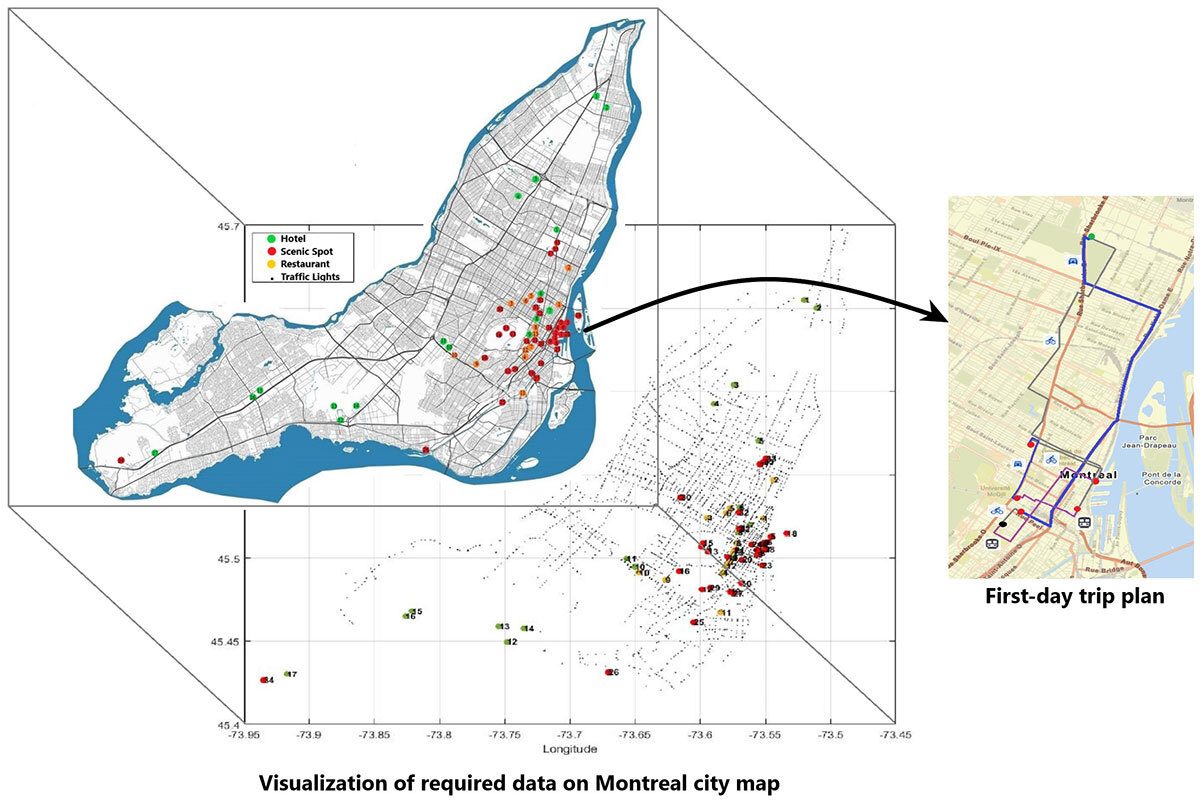
Managerial insights are as follows:
- The method supports customized trip designs balancing sustainability dimensions, helping tourists make informed trade-offs.
- Inclusion of real-world transport complexities (traffic lights, weather, mode-specific costs/emissions) improves realism and plan reliability.
- Walking and biking significantly reduce emissions; policies improving pedestrian infrastructure can promote sustainable tourism.
- Three budget levels critically shape various available trade-offs; larger budgets allow more flexibility, but do not automatically improve all objectives.
- SA-NSGA-II offers a practical solution for large-scale trip planning where exact methods are too slow.
This study advances research on personalized trip planning by jointly integrating (1) all three sustainability dimensions, (2) multimodal urban transport with real operational complexities, and (3) uncertainty modeling using fuzzy logic. Such features are rarely addressed together, especially for individual (non-group) planning. The proposed SA-NSGA-II demonstrates scalability and robustness, making it suitable for real-world applications.
Additional Information
To learn more about this research, please read the following research paper:
Aliahmadi, S. Z., Jabbarzadeh, A., & Hof, L. A. (2025). A multi-objective optimization approach for sustainable and personalized trip planning: A self-adaptive evolutionary algorithm with case study. Expert Systems with Applications, 261, 125412.