October 19, 2026
When an engineer develops a technology and proof of concept is completed, the technology must be validated in a simulated environment and in the laboratory before moving on to field studies (readers are referred to the technology maturity levels recommended by Innovation Canada). A technology that interacts with humans must also undergo validation, a responsibility for engineers adequately trained in human factors and ergonomics engineering (HFE) and occupational safety.
The objective of HFE is to adapt work to workers, improving well-being and increasing effectiveness and efficiency on the job. Whether designing a tool, machine, or piece of equipment; an artificial intelligence algorithm; or a work system, digital human modeling analysis (DHM) and laboratory usability studies are essential.
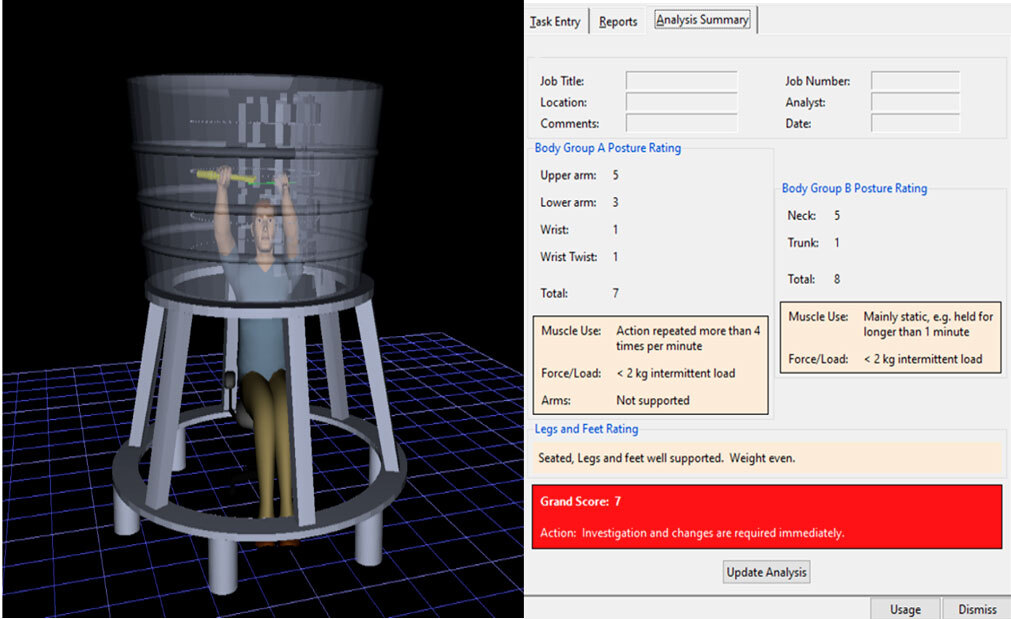
Djefour et al. (2025b)
Anticipating physical constraints using virtual mannequins
When the actual work environment does not exist, or access to the site is difficult or even impossible, softwares such as Siemens PLM Software (JACK), Ema/imk, Dassault Systèmes’ 3DEXPERIENCE (CATIA), and others can be used to create virtual mannequins representative of a population within a simulated, realistic work environment. These virtual environments allow modelling of physical variables and some organizational variables (frequency and duration) to study their impact on reach zones, access and clearance, the musculoskeletal system (Djefour et al. 2025b), vision (Valdesse Eko’Ola and Nadeau 2025), and more.
The work environments depicted are, of course, more narrowly defined as systems (workstations). Not all ergonomic analysis tools are included; however, research to improve the software is underway (e.g., Tiaya et al. 2022). 2022). Nevertheless, for the sake of scientific rigour, risk analyses of musculoskeletal injury, for example, can be supplemented by direct observation methods outside the virtual environment but based on it, using traditional approaches such as the Key Indicator Method (KIM), Occupational Repetitive Action method (OCRA), or Ergonomic Assessment Worksheet (EAWS). It is also possible to formulate recommendations for work system adaptations based entirely on the virtual environment.
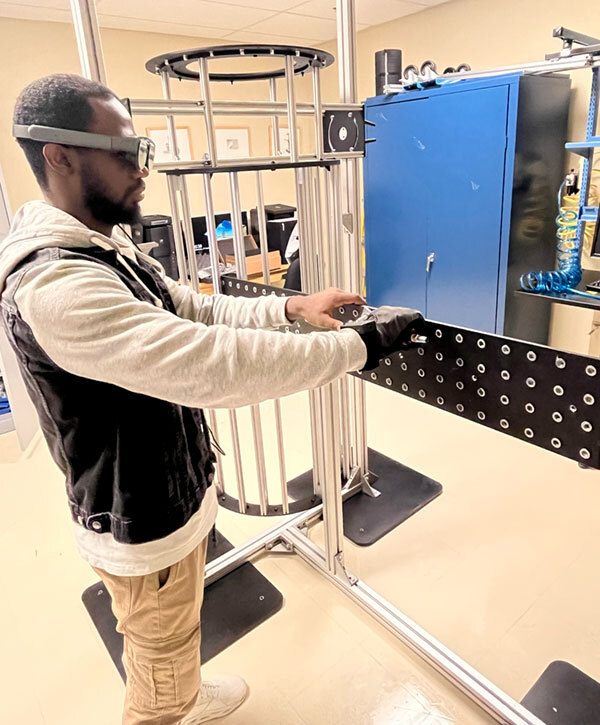
Evaluating performance and workload
Whether for a prototype or a commercial product, usability is defined in ISO 9241-11 (2018) as “the extent to which a system, product or service can be used by identified users to achieve specified goals with effectiveness, efficiency and satisfaction in a specified context of use.” Thus, usability studies aim to understand why end-user (including workers) performance is not optimal, what factors influence it, and how to improve it, while identifying the key factors that may increase workload. The HFE variables studied include not only time and error variables but also issues related to physical and cognitive workload. Traditional ergonomic analyses are used (Landau and Nadeau 2026 and 2020)—from task analysis and observation to various biometric measurements (heart rate, movements, eye fixations and saccades, electrical muscle activity, movements and angles between body segments, and exertion levels) during laboratory experiments, as well as eliciting end-user perceptions (NASA-TLX) or expert opinions.
Testing ergonomics before fieldwork
Activities of the Applied Human Factors Laboratory, affiliated with the Products, Processes, and Systems Engineering Laboratory at the École de technologie supérieure (ÉTS), are listed as follows:
- DHM studies formulating preliminary recommendations for workplaces in the mining (Roque et al. 2014), aerospace (Nadeau et al. 2019), automotive dismantling (Boniface Awatcha et al. 2026), and artistic ceramics sectors, to name a few;
- Usability studies in the manufacturing, construction, and mining sectors (Ngô et al. 2020), in assembly/disassembly digitization (Djefour et al. 2025, Valdesse Eko’Ola and Nadeau 2025, Khoddammohammadi et al. 2023), and in inventory management, logistics, and distribution;
- Field studies in aerospace (LeFloch et al. 2021, Torres et al. 2021), energy, mining, manufacturing, construction, mechanical engineering and automotive dismantling, transportation, healthcare, food processing and distribution, and residential and commercial moving.
Digital Human Models and usability studies are part of a technological development continuum that precedes field studies. Their value in the design process is undeniable. Although they do not allow for the analysis of all parameters of a work system, they are highly recommended before delving deeper into HFE issues in the field. Sometimes, in some contexts, they remain the only viable option for addressing specific HFE issues until field sites become accessible.
For further insight, the following are some recommended courses at ÉTS:
- Undergraduate level (course in French): GIA-602 Ergonomie et sécurité en milieu industriel (Ergonomics and Safety in Industrial Settings)
- Graduate level (cours in French): ERG-801 Conception et choix d'outils et d'équipements (Designing and Selecting Tools and Equipment)
References
Boniface Awatcha, W., Hof, L., Nadeau, S. (2026). Linking Ergonomics and Life Cycle Assessment in Catalytic-Converter Disassembly: Implications for Worker Protection and Recycling Efficiency. En cours d’évaluation, Journal of Remanufacturing.
Djefour, D., Nadeau, S., Landau, K. (2025). Analyse des interfaces homme-outil : comprendre les paramètres clés de ces interfaces - étude exploratoire avec un gant de données (VMG30). Communication lors de la conférence : Congrès annuel AQHSST (Drummondville, QC, Canada, 21-22 mai 2025).
Djefour, D., Nadeau, S., Landau, K. (2025b). Digital Human Modeling for long, and low-volume assembly processes: Gas turbine assembly case study. Open Journal of Safety Science and Technology, vol. 15, nº 3.
ISO (2018) Ergonomie de l'interaction homme-système Partie 11: Utilisabilité — Définitions et concepts, ISO 9241-11:2018. 32 pages.
Khoddammohammadi, N., Ngô, V., Nadeau, S. (2023). Integrating smart glasses in a hybrid manufacturing system: Towards a better understanding of impacts on productivity, quality and ergonomics/human factors. CIGI Qualita MOSIM : Propulser la performance - Interconnectivité et collaboration dans un contexte d'intelligence artificielle (Trois-Rivières, QC, Canada, June 14-16, 2023) Université du Québec à Trois-Rivières.
Landau, K., Nadeau, S. (2026). Case study on the assessment effort of the Key Indicator Method for Awkward Body Postures (KIM-ABP). Open Journal of Safety Science and Technology, vol. 16, nº 3. p. 115-137.
Landau, K., Nadeau, S. (2020). Comparison of different parameters of heart rate frequency of tasks performed during aircraft open-basket ground deicing activities. Ergonomics International Journal, vol. 4, nº 6.
Le Floch, T., Nadeau, S., Morency, F., Landau, K. (2021). Identification of physically fatiguing tasks performed during aircraft open-basket ground de-icing activities. Work: A Journal of Prevention, Assessment & Rehabilitation, vol. 68, nº 3. p. 789-796.
Nadeau, S., Salmanzadeh, H., Ahmadi, M., Landau, K. (2019). Aviation deicing workers, global risk assessment of musculoskeletal injuries. International Journal of Industrial Ergonomics, vol. 71. p. 8-13.
Ngô, V., Nadeau, S., Hallé, S. (2020). Validation of ergonomic criteria of a cooling vest for deep and ultra-deep mining. International Journal of Industrial Ergonomics, vol. 78.
Roque, N., Nadeau, S., Badri, A. (2014). Preliminary ergonomics of a bolting machine and a drill used in underground mining. Kongress der Gesellschaft für Arbeitswissenschaften - Gestaltung der Arbeitswelt der Zukunft (Munich, Germany, Mar. 12-14, 2014) GfA-Press.
Tiaya Tedonchio, C., Nadeau, S., Boton, C., Rivest, L. (2022). Digital mock-ups as support tools for preventing risks related to energy sources in the operation stage of industrial facilities through design. Results in Engineering, vol. 16.
Torres, Y., Nadeau, S., Landau, K. (2021). Evaluation of fatigue and workload among workers conducting complex manual assembly in manufacturing. IISE Transactions on Occupational Ergonomics and Human Factors, vol. 9, nº 1. p. 49-63.
Valdesse Eko'Ola, V., Nadeau, S. (2025). Systematic selection of visual and cognitive assistance equipment: Case of gas turbine assembly in narrow spaces. Intelligent control and automation vol. 16, nº 3, pp. 80-109.