April 20, 2026

As the impacts of climate change intensify, some regions of the world are on the front lines and facing multiple sources of pressure. Floods, heat waves, rising sea levels, and soil instability are undermining living conditions and exacerbating inequalities. This is the backdrop to the consortium on Participatory Approaches for Regenerative Climate Solutions (PARCS), an international research project exploring how to co-create sustainable adaptation and mitigation solutions with local communities.
The project is based on three living labs located in highly vulnerable areas: Medellín (Colombia), Indramayu Regency (Indonesia), and Port Arthur, Texas (United States). These sites are testing grounds for a three-step participatory approach: first, assessing risks and needs based on local knowledge; second, co-designing regenerative solutions through collaborative processes; and finally, for Colombia, the actual implementation of these solutions.
Medellín: Addressing urban vulnerability through local knowledge
As Colombia’s second-largest city, Medellín has a population of approximately 2.5 million, with nearly 4 million in the entire metropolitan area. Nestled in the Aburrá Valley, in the heart of the Andes, it offers a stark contrast between urban development and precarious living conditions. Many informal settlements, built on unstable land by displaced populations, are exposed to environmental risks.
The living lab focuses on La Iguaná micro-watershed, specifically on two micro-territories identified for their social and environmental vulnerabilities. In the field, researchers work closely with communities to develop solutions tailored to their specific context.
Carolina Moreno Londoño, a PhD student at ÉTS, is developing a methodology promoting the co-design of regenerative solutions. The first areas identified include the creation of community and family gardens, which contribute to food security while strengthening social ties. These initiatives reflect a strong desire among residents to preserve the rural character of their environment and limit the expansion of large-scale construction.
Meanwhile, Pierre Boucher, also a PhD student at ÉTS, is exploring the potential of Colombian bamboo (Guadua angustifolia) in construction. As a fast-growing renewable material, bamboo offers significant environmental and economic benefits. Although it has long been used in vernacular architecture, its integration into contemporary practices is limited.
Boucher is researching ways to develop adaptive assembly systems to ensure the performance and reliability of bamboo structures. The goal is to facilitate the use of this material in sustainable construction projects, especially in vulnerable contexts.
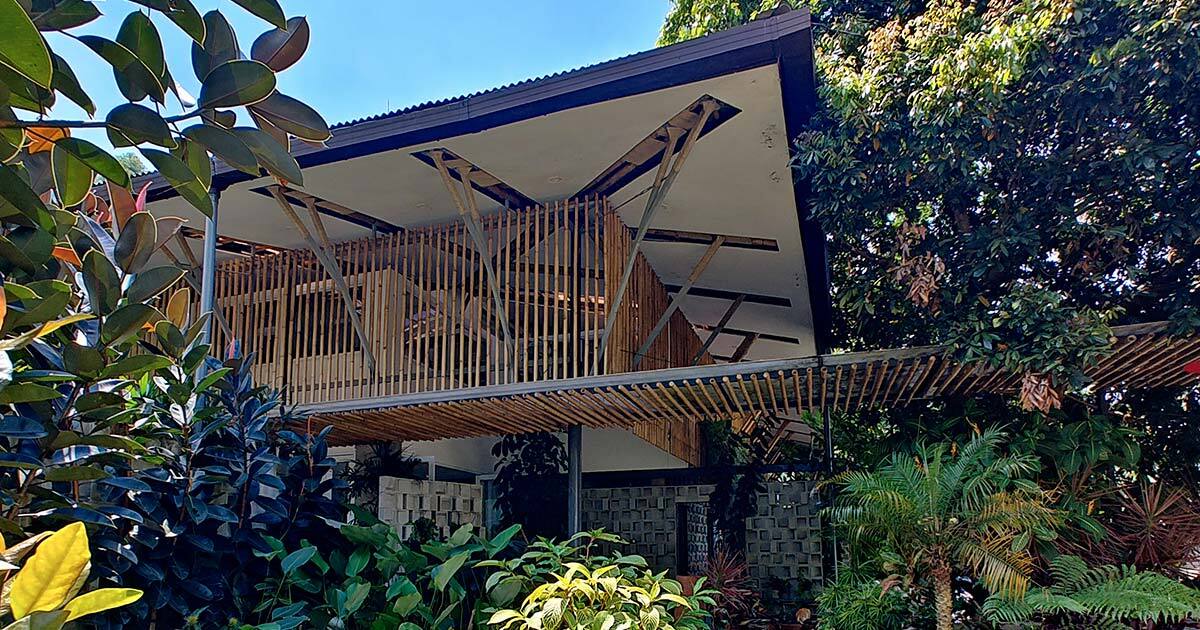
Bamboo in construction, example from Indonesia (credit photo Claudiane Ouellet-Plamondon)
Finally, Ricardo Pérez-Restrepo, a PhD student at ETH Zurich, is studying the dynamics of informal urbanization. Using ethnographic approaches, he analyzes local construction practices and their underlying social logic. He is developing decision-making tools integrating sociocultural dimensions to promote sustainable solutions that are truly rooted in the local context.
Indramayu: Living with water
On the northern coast of West Java, Indonesia, the Indramayu living laboratory is located in a highly vulnerable environment. This low-lying region faces daily tidal flooding, known as rob. These events are exacerbated by land subsidence—caused primarily by groundwater and oil extraction—which can reach up to 54 mm per year, far exceeding the rate of sea-level rise.
In this context, researchers at the University of Bath are using satellite data and models to understand how flooding is evolving. However, the accuracy of these forecasts is limited due to the lack of reliable topographic data. One thing is certain: the current difficult conditions will continue to deteriorate.
Despite these risks, local communities maintain a strong connection to their land, often tied to their livelihoods. While the authorities have initiated relocation projects, these raise many questions, especially since the resettlement areas themselves could become vulnerable in the medium term.
Two PhD students from the Bandung Institute of Technology play a central role in this research group. Choerunisa Noor Syahid focuses on the sociocultural dimensions of adaptation, exploring how communities perceive water and organize their daily lives around this resource. Her approach highlights the importance of local knowledge and culture in resilience strategies.
Allamah Yahya Qolbun Salim analyzes the interactions between the various stakeholders involved in relocation decisions, whether from the government or the communities.
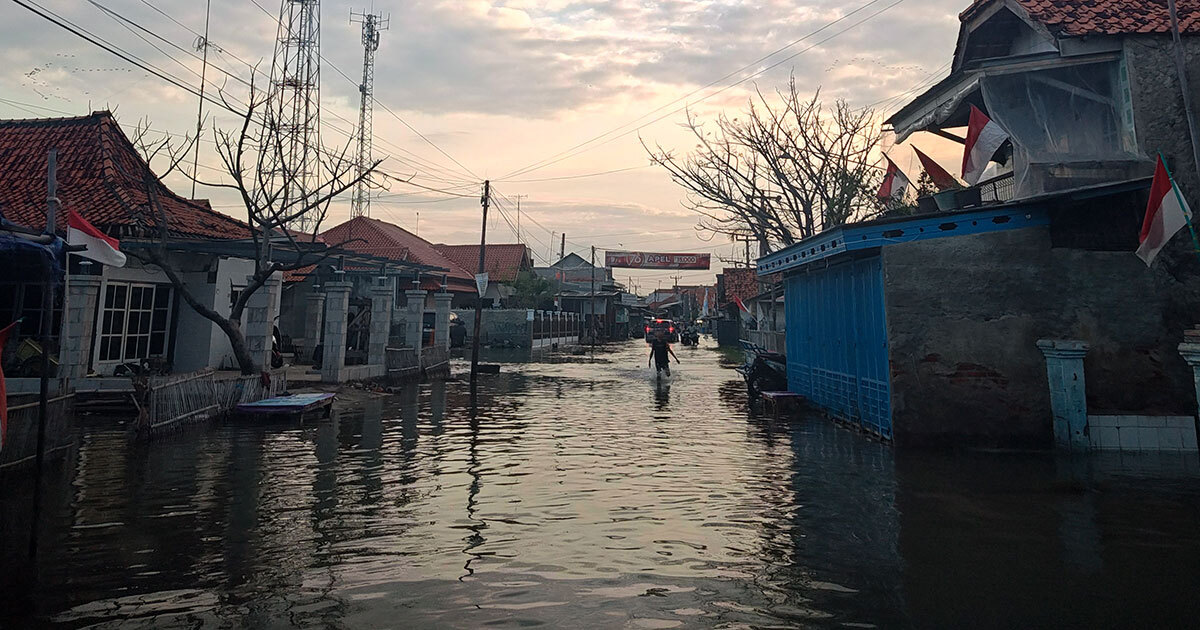
A flood-prone coastal area where residents must be relocated (credit photo Claudiane Ouellet-Plamondon)
Architectural aspects are also being explored, notably by Aoife Wiberg of the University of Florida, who is focusing on the use of renewable materials such as bamboo. Meanwhile, Norway’s NTNU is developing visualization and simulation tools to understand the risks and explore solutions collectively. Postdoctoral researcher Bintang Noor Prabowo plays a pivotal role here by linking technical approaches to local contexts, ensuring that the proposed solutions are both culturally relevant and sustainable.
Port Arthur: Rebuilding despite cumulative risks
In the United States, the city of Port Arthur, Texas, faces a combination of climate-related risks: hurricanes, floods, storm surges, and heat waves, all exacerbated by rising sea levels in an area exposed to other social and environmental issues. These recurring events compromise homes, resulting in high repair costs and degrading living conditions, notably by promoting mould growth and causing structural damage.
The most vulnerable populations are severely affected, as they face increased risks of displacement and difficulties in rebuilding. Compounding these issues are cascading infrastructure failures, which weaken the region’s overall resilience.
To address these challenges, a multidisciplinary team led by researchers from Texas A&M Universityincluding doctoral student Mana Nemati Aghdam, is conducting participatory research on the exposure of residential buildings to climate hazards and the development of appropriate design guidelines.
The project is based on the participation of local communities. A survey was first conducted to identify residents’ main concerns regarding housing damage and barriers to resilience. Focus groups and interviews were then organized with residents, community organizations, and municipal officials to gather a range of perspectives.
These discussions help identify the region’s specific vulnerabilities and the challenges at each stage of disasters, from preparedness to reconstruction. The results will inform the design of participatory workshops and a knowledge co-production toolkit.
An approach rooted in the local communities
Through these three living laboratories, the PARCS project highlights the importance of a collaborative and context-specific approach to climate change in areas facing multiple pressures. By integrating local knowledge, sociocultural realities, and environmental constraints, the objective is to foster regenerative solutions that sustainably strengthen community resilience.
Beyond technical solutions, a new way of designing climate action is taking shape: an approach based on listening, participation, and co-creation, where communities are no longer mere beneficiaries but full-fledged agents of change.
The project is backed by the “New Frontiers in International Research Fund,” a joint initiative of three government agencies supporting multidisciplinary and international collaborations. At ÉTS, it is led by Diego Ramirez Cardona and Claudiane Ouellet-Plamondon (nominee for principal investigator). The international co-principal investigators are Harlem Acevedo Agudelo (Instituto Tecnológico Metropolitano), Adiwan Aritenang (Institute of Technology Bandung), Manish Kumar Dixit (Texas A&M University), Guillaume Habert (ETH Zurich), Aoife Houlihan Wiberg (University of Florida), Diego Ramirez Cardona (École de technologie supérieure), Liliana Restrepo Medina (Instituto Tecnológico Metropolitano), Nurrohman Wijaya (Institute of Technology Bandung), and Arild Gustavsen (Norwegian University of Science and Technology). The international co-applicants are Chris Blenkinsopp (University of Bath), Christina Demski (University of Bath), Tristan Kershaw (University of Bath), Donny Koerniawan (Bandung Institute of Technology), Jaimie Masterson (Texas A&M University), Jayanta Mondol, Freja Nygaard Rasmussen (Norwegian University of Science and Technology), and Daniel Satola, (Norwegian University of Science and Technology). The project officially began in 2025 and will conclude in early 2028.