January 28, 2026

Abstract
The current research presents an AI-enabled framework that reconstructs the time history of wind loads on tall buildings using only a limited number of sensors. Instead of relying on hundreds of sensors, the framework uses advanced hybrid artificial intelligence (AI) techniques to leverage data from a sparse sensor network and predict the full-time history of wind loads on the building façade. By using time-history data from a few wind pressure taps (as the main sensing system) on the building façade, a time-series prediction model is used to translate the signals from these sensors into a detailed map of wind loads over time, on all sides of the building. This approach aims to reduce costs and complexity while providing the detailed information needed for safe and efficient structural design and real-time structural health monitoring.
From Multiple Sensors to Smart Sensors
The proposed framework, as shown in Figure 1, links sparse measurements on a building façade to a full, time-varying distribution of wind loads in a way that is usable to practicing engineers. It starts with a few sensors on the building façade. As few as five sensors are enough. The sensors in this study are pressure taps that measure wind pressures on the building faces. The wind pressure directly provides the wind loads by multiplying it by the face areas. Using the signals recorded by these sensors, the full-time history of wind pressures and, consequently, wind loads can be obtained for the whole building.
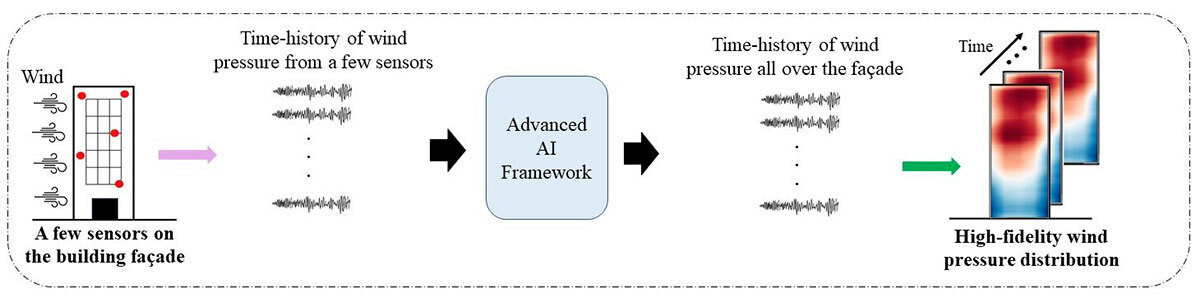
Figure 1: Advanced hybrid AI framework for predicting wind loads on building façades
To make the framework more efficient and reliable, dimensionality reduction techniques were used. Thus, instead of learning the pattern for the whole high-dimensional space, the AI framework, using advanced deep learning models, learns the reduced dynamics of the wind load pattern over the building. This way, it can be fast while remaining reliable.
Constraints on building façades for the installation of the sparse sensor network are also considered. For example, in some places, sensors cannot be installed for architectural or aesthetic reasons, or sometimes because there is no access. But in other locations, sensors may be necessary due to their importance or priority. Also, the number of sensors may be limited due to budget issues. All these constraints are considered in the proposed framework.
This framework is trained using a database of wind tunnel tests. From this reference database, the model then learns how local pressures (and corresponding loads) at these key locations evolve and how they relate to the dominant patterns on the whole façade. This relationship is captured by an advanced form of recurrent neural networks (advanced long short-term memory networks), a type of machine learning model designed to process time series. Its input is the time history recorded by the selected sensors, together with basic information such as wind direction. Its output is the intensity of each spatial pattern at every point in time. By recombining these patterns, the framework reconstructs a detailed map of wind-induced loads across the façade throughout the duration of the wind event.
Case Study and Results
The framework is demonstrated using a well-known experimental database for a tall building from Tokyo Polytechnic University. In the original wind tunnel study, hundreds of pressure taps were installed on the façades, and pressures were recorded for multiple wind directions. This rich dataset serves as the “ground truth” for wind loads on the façades, against which the AI-enabled framework is evaluated, in the same way a reference test is used to check a simplified design method.
Several sensor constraints are evaluated, ranging from practical configurations with a few dozen sensors, down to an extreme case with only five sensors on a façade. For each constraint, the model receives only the signals that would be measured at the selected locations and attempts to reconstruct the full load field in space and time, derived from the underlying pressure data.
The reconstructed loads are compared with the original tap-based results using advanced error metrics and visual inspection of load snapshots (as shown in Figure 2) and time histories at selected points. This has been implemented for all building faces, including windward (directly exposed to the wind), leeward (on the back side of the wind), and side faces. Overall, the framework successfully recovers the main load patterns using limited data.
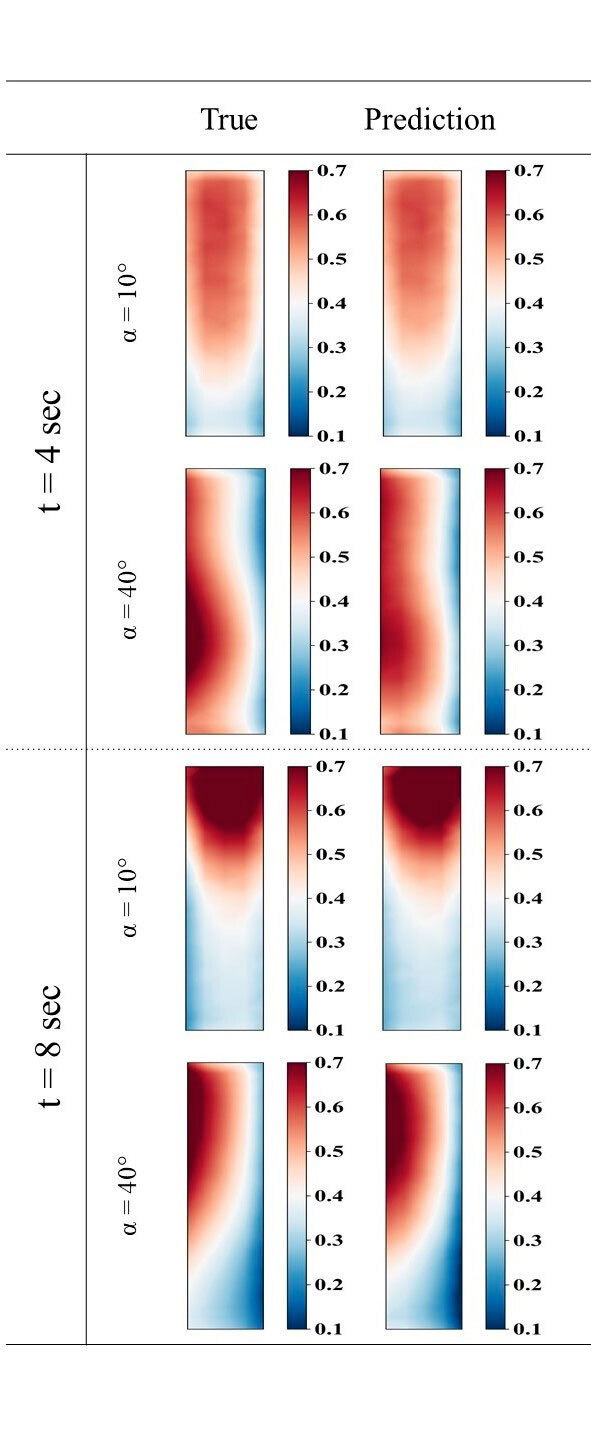
Figure 2: A comparison of true results and the predictions from the AI framework, at two different time steps and for two different wind directions
Real-World Application
The proposed framework targets situations where detailed wind load information on building façades is valuable but where dense instrumentation is impractical, a scenario familiar to many engineering fields. In wind tunnel testing, it can support more economical efforts by reducing the number of pressure taps needed to obtain façade-wide load maps. This can help laboratories handle more complex or customized studies within realistic budgets and schedules.
In real buildings, the same approach can be integrated into digital twin or health monitoring platforms. A limited number of permanent sensors, installed at strategically selected locations, can provide the input required for the AI framework to estimate wind loads over the entire façade during windstorms. Such information can be used for performance assessments of cladding systems, guide inspections after extreme events, and support the calibration of numerical models used by design offices.
This framework is also relevant for retrofit and design studies. Engineers can test different sensor layouts virtually, identify the most informative configurations, and use them to monitor critical structures such as landmark towers, stadiums or long-span roofs. Although the model still requires an initial high-quality reference dataset for each building type, it offers a practical path toward smarter, data-driven wind engineering, where measurements, simulations and AI work together to improve safety, serviceability and cost-effectiveness in everyday design practice.
Additional Information
For more information on this research, please refer to the following research paper: Nav, F. M., Mirfakhar, S. F., & Snaiki, R. (2025). A hybrid machine learning framework for wind pressure prediction on buildings with constrained sensor networks. Computer-Aided Civil and Infrastructure Engineering, 40, 2816–2832.