
January 1, 2026
Background and problem statement
Embedded systems, particularly in the space sector, must now process growing volumes of data with limited power and computing resources. This constraint leads to a dependency on ground infrastructure, decision-making delays and high transmission costs.
In a context marked by the rise of NewSpace, artificial intelligence and critical autonomous systems, these limitations hinder performance, resilience and technological sovereignty.
Research objective
To design and validate an onboard artificial intelligence platform capable of executing optimized models on low-power systems, in order to enable real-time data processing directly at the source.
The objective is to reduce dependency on ground infrastructure, accelerate decision-making and strengthen the autonomy of critical systems.
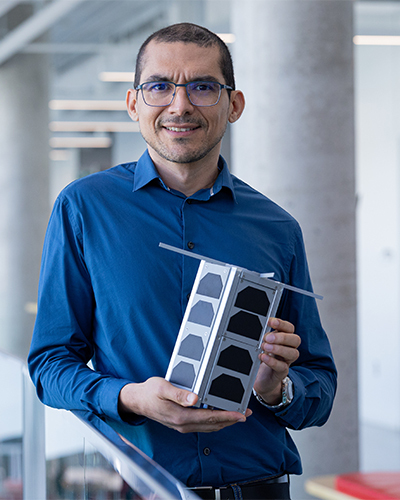
David Gonzalez Llorente, research professor in the Department of Aerospace Engineering.
Background and problem statement
- Embedded systems, particularly in the space sector, must now process growing volumes of data with limited power and computing resources. This constraint leads to a dependency on ground infrastructure, decision-making delays and high transmission costs.
- In a context marked by the rise of NewSpace, artificial intelligence and critical autonomous systems, these limitations hinder performance, resilience and technological sovereignty.
Innovation and key differentiators
- Modular platform combining embedded artificial intelligence, optimized models, and prototyping environments suited for spatial constraints.
- Greater operational autonomy
- Improved mission resilience
- Reduced decision latency
- Lower data transmission costs
Expected benefits
- Greater system autonomy
- Real-time decision-making
- Reduced data transmission costs
- Operational resilience in hostile environments
Target sectors
This technology is designed for several strategic sectors:
- Space and NewSpace (CubeSats, Earth observation)
- Aerospace and defence systems
- Autonomous robotics
- Intelligent transportation
- Critical infrastructures
Results and validation
Preliminary work has led to the development of functional prototypes capable of prioritizing images and detecting anomalies, using AI models optimized for low-power embedded platforms.
Early validation tests have confirmed the viability of real-time local processing in constrained environments.
Research challenges
- Validating and certifying autonomous systems
- Access to test infrastructure representing the space environment
Technology readiness level (TRL)
Current stage: Research prototype undergoing experimental validation.
What is needed to accelerate the project
- Access to real-life data and validation platforms
- Opportunities for demonstrating in operational conditions
Partnerships
We are looking for industrial and institutional partners to accelerate development and implementation:
- Space and NewSpace innovators
- Embedded and electronic systems companies
- Organizations using critical autonomous systems