April 15, 2026
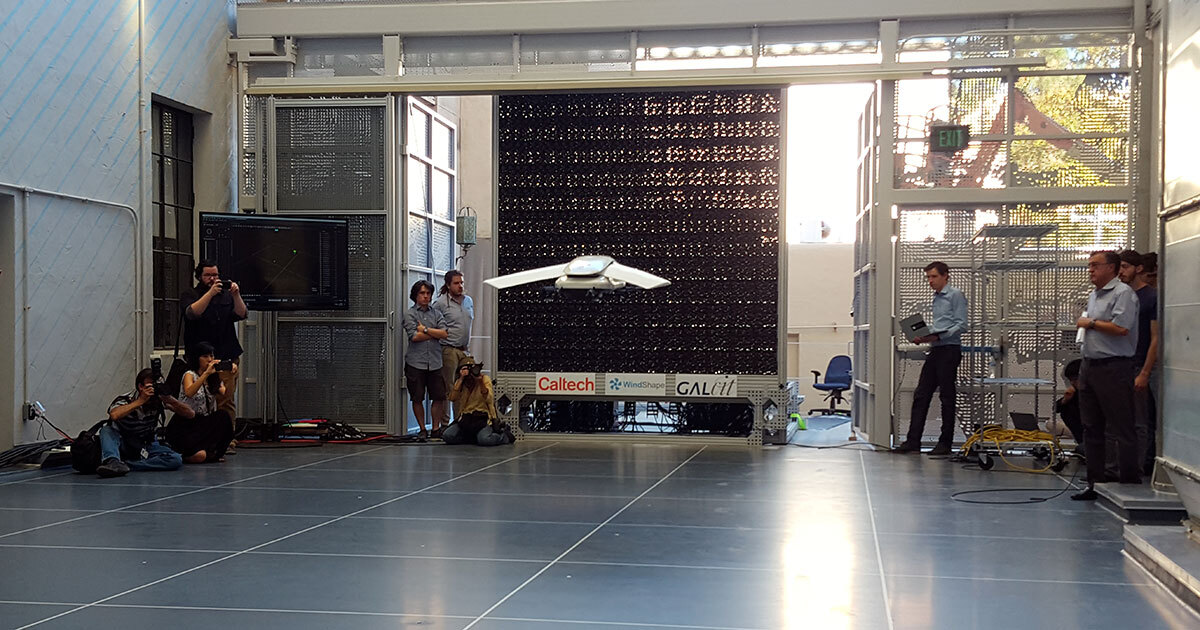
Flying a drone reliably is a far more complex challenge than it seems. Unlike airplanes, which fly in relatively stable conditions at high altitudes, drones operate in the lower atmosphere, where wind is unpredictable, turbulent, and often hostile. This is the challenge that drives Flavio Noca, professor of Aerospace Engineering at ÉTS, specialist in fluid mechanics and pioneer of a new generation of wind tunnels.
When wind tunnels reach their limits
For over a century, wind tunnels have been essential tools for aircraft testing. They allow researchers to reproduce “relative wind”—the wind resulting from the aircraft forward motion—under controlled and reproducible conditions. To achieve a uniform airflow, turbulence is reduced using grids and honeycomb structures. But this approach, perfectly suited for airplanes, has its limitations when it comes to drones.
Drones do not fly in a straight line through stable air: they are constantly buffeted by gusts and wind shear. Furthermore, they operate at low altitudes, where weather conditions are far more chaotic: rain, snow, fog, icing… all phenomena absent at aircraft cruising altitudes. The few wind tunnels capable of replicating these phenomena are generally limited to calm flight conditions.
Consequently, testing drones in wind tunnels designed for airplanes comes down to oversimplifying a much more complex reality.
An idea inspired by birds
It was while watching seagulls glide in the wind that Flavio Noca found the solution: what if, instead of restricting the drone, we recreated a realistic, wall-less flight environment where it could move freely?
From this insight emerged a radical concept: an open wind tunnel capable of replicating complex and variable winds, as well as real-world weather conditions.
Pixelating wind
To bring this vision to life, Flavio Noca and his former student Guillaume Catry developed a novel approach: replacing the single fan found in traditional wind tunnels with a multitude of small, independent fans.
The principle is simple yet powerful. Each fan acts as a “wind pixel,” with speeds that can be controlled individually. By combining them, an infinite number of configurations can be generated: gusts, wind shear, and turbulence.
These fans are grouped into modules of nine units, assembled like LEGO bricks. This modularity, now patented, makes it possible to build wind tunnels of various shapes and sizes, tailored to the specific needs of the tests.
The result: a “pixelated” wind surface capable of reproducing complex, time-varying flows.
This innovation addresses a critical need in the drone industry. Until now, real-world testing depended on weather conditions, making it difficult to replicate and compare results. With this next-gen wind tunnel, it is now possible to test drones under controlled conditions while maintaining a high level of realism.
The technology is so promising that NASA has used it to test a drone intended for a Mars mission—an environment where atmospheric conditions are even harder to predict.
Understanding turbulence: A scientific challenge
While generating complex winds is now possible, understanding them remains a major challenge. The flows produced by the pixelated wind tunnel look more like a “washing machine” than the steady flows of conventional wind tunnels. However, current digital tools cannot accurately simulate this type of large-scale turbulence. Experimentation remains essential.
To analyze these flows, researchers use advanced techniques such as particle image velocimetry. By injecting tiny particles into the air and illuminating them with lasers, they can reconstruct three-dimensional velocity fields and sometimes even pressure fields.
But these complex and costly methods need to evolve to handle larger air volumes and more turbulent flows.
Wind mapping at the drone scale
Ultimately, the goal is ambitious: to reproduce in the laboratory real-world winds measured in the field.
Today, weather models describe the atmosphere on scales of several kilometres. However, a drone is sensitive to much finer variations, especially around buildings or near the ground.
Accordingly, a new field of research is emerging: small-scale wind mapping. By combining this data with artificial intelligence, it will be possible to train wind tunnels that faithfully reproduce real-world conditions.
Drones inspired by birds
At the same time, Flavio Noca is looking into designing drones inspired by living organisms. Part of his work focuses on aircraft that mimic large seabirds, such as albatrosses and pelicans.
These birds leverage aerodynamic effects near water surfaces to conserve energy, using air cushions and reducing the effect of wing-tip vortices. Understanding these mechanisms could lead to the design of more efficient drones, travelling long distances with reduced energy consumption.
The benefits of this research are numerous. In Africa, for example, large drones could transport medicines along rivers, bypassing natural obstacles and limited infrastructure.
Other drones, capable of sustained flight by leveraging turbulence, could serve as mobile weather stations, collecting high-resolution data without requiring frequent battery changes.
Bridging the gap between experimentation and simulation
By pushing the boundaries of experimentation, Flavio Noca’s pixelated wind tunnel paves the way for a better understanding of turbulent flows and, ultimately, for the design of more robust drones capable of withstanding the most extreme conditions.
Whether it’s exploring Mars or delivering medicine to remote areas, one thing is clear: to make the drones of tomorrow fly, we must first master the wind in all its complexity.