February 2, 2026
A common procedure, yet far from trivial
Inserting a peripheral venous catheter is one of the most frequently performed invasive procedures in Canadian hospitals. Between 60% and 90% of hospitalized patients receive one to achieve a rapid administration of fluids, medications, or blood products. Despite its routine nature, this procedure is associated with a high rate of failure and complications, especially when multiple attempts are required. These failures can damage veins, cause pain, and, in some cases, lead to more serious complications, such as catheter leakage.
When veins are clearly visible on the skin surface, insertion is usually performed without assistance. However, in many patients (elderly, obese, or suffering from certain conditions), veins are difficult to locate. Moreover, it is sometimes necessary to insert the catheter into larger veins located deep within the body, which are not visible on the surface. In such situations, the ultrasound-guided method is being increasingly used to enhance success rates.
The challenges of ultrasound guidance
Ultrasound guidance is the use of ultrasound to visualize the target vein and monitor the needle's progress during insertion. Although this approach has proven effective, it is difficult to master. One main issue is the two-dimensional nature of ultrasound images, which requires clinicians to constantly make connections between what they see on the screen and the patient's actual three-dimensional anatomy.
This complexity explains why ultrasound-guided catheter insertion is difficult to teach and learn, with anesthesiologists historically being the main specialists in this field.
A device developed by SonoNurse to guide the procedure
SonoNurse Inc., incubated at Centech, was founded to address these challenges, among others, at the initiative of an anesthetist from the Quebec health network. The company has developed a medical device designed to facilitate the insertion of peripheral venous catheters using ultrasound guidance.
The SonoNurse device physically attaches the catheter needle to the ultrasound probe using a mechanical arm. This configuration limits the needle’s movement so that it remains in the plane of the ultrasound image once the vein has been located.
The key role of the simulator designed at ÉTS
Before considering clinical trials, it was essential to validate the actual usefulness of the device while avoiding putting patients at risk. ÉTS professor Simon Drouin and his student, Alejandro Olivares Hernandez, developed a virtual reality medical simulator specifically designed to replicate the ultrasound-guided catheter insertion procedure.

ÉTS Professor Simon Drouin
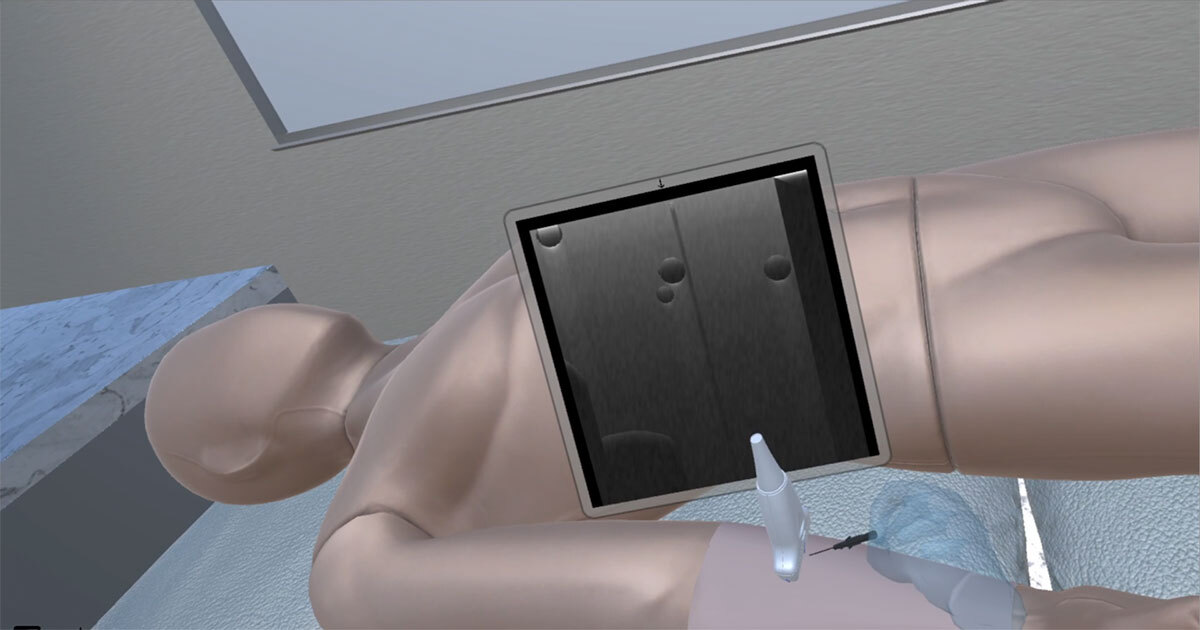
The simulator allows the procedure to be tested (with or without the SonoNurse device) in a controlled and reproducible environment. Learners wear a virtual reality headset in which they see a virtual patient in a realistic hospital setting. They hold a needle and an ultrasound probe, while a simulated ultrasound image is displayed as in a real clinical setting. Users can repeat the procedure as many times as they wish, and the system is able to evaluate their performance, especially their accuracy in relation to the target vein.
Thanks to this simulator, the team was able to demonstrate that beginners performed significantly better when using the SonoNurse device than when performing the procedure without assistance.
From virtual to tactile: Integrating haptic feedback
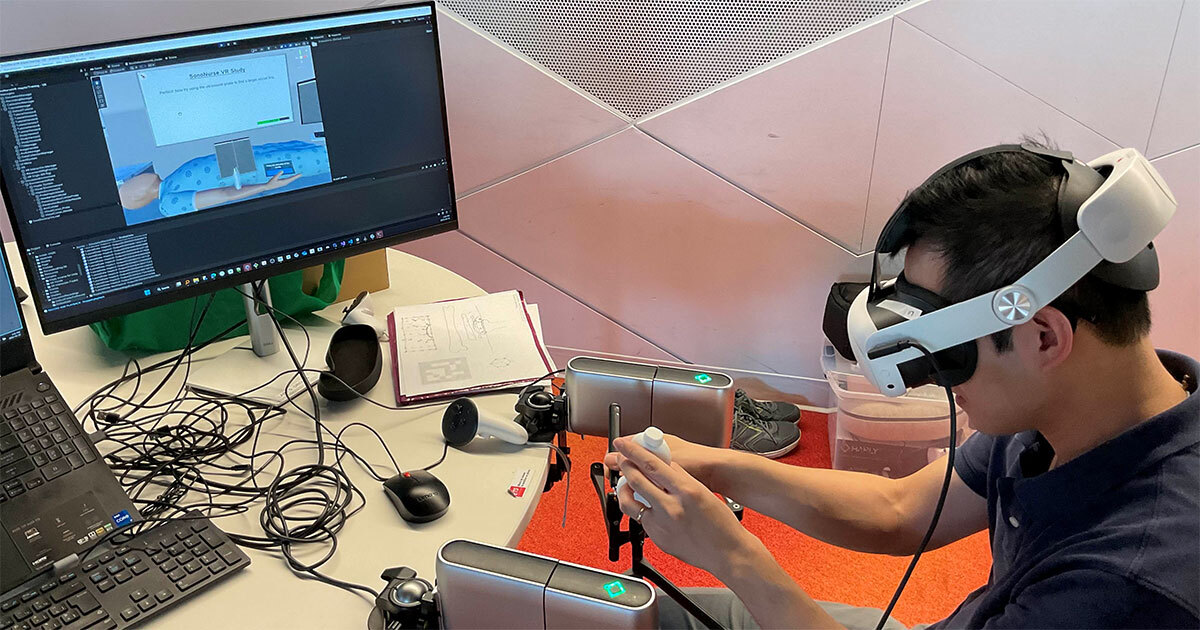
An early version of the simulator relied on the use of a virtual reality headset and standard controllers to replicate the needle and probe. To make the experience more realistic, Simon Drouin and his student, Naomi Catwell, developed a second version incorporating haptic force feedback.
Two small robotic arms exert physical resistance, creating the illusion of contact with human tissue. A 3D-printed ultrasound probe replica is attached to one of the robots, while a replica needle is attached to the other. When users insert the needle into the virtual patient's arm, they feel a resistance mimicking the passage through layers of tissue. This tactile feedback enhances the realism of the simulation and improves the quality of learning.
Exploring augmented reality to reduce cognitive load
The third part of the project, led by ÉTS student Zakaria-Meziane Souadda, focuses on the potential of augmented reality. In clinical practice, the ultrasound image is displayed on a screen separate from the probe, requiring constant mental effort to make the connection between the position of the probe, the image displayed, and the patient's anatomy.
The research team is exploring the possibility of displaying the ultrasound image directly where it should be, as if looking through the patient's arm. Rather than testing this approach directly in a clinical setting, it was integrated into the virtual reality simulator. A student is now comparing the ease of performing the procedure when the image is displayed directly on the virtual patient's arm, compared to the more traditional setup with a separate screen.
Complementarity between industrial innovation and university research
Overall, the SonoNurse project is based on close complementarity between industrial innovation, with the device developed by SonoNurse, and academic research, with the simulator designed by Simon Drouin and his team at ÉTS. By combining physical devices, virtual reality, haptic feedback, and augmented reality, the project paves the way for more effective, safer training better suited to current clinical realities, benefiting both healthcare professionals and patients.
The work carried out at ÉTS on this simulator will also make it possible to test new clinical approaches and facilitate the actual procedure on patients, thanks to augmented reality.
Simon Drouin is a member of itechsanté, the ÉTS research institute for innovation in health technologies. To learn more about the institute, its mission, themes, flagship projects, and more, visit itechsanté.