
June 1, 2026

Beyond the Gantt Chart: Rethinking Construction Site Management
In the collective imagination, planning a construction site often means rolling out a neat, orderly schedule where each activity logically follows the next over time. For over a century, the Gantt chart has embodied this vision. Yet, on the ground, the reality is quite different. It is precisely this gap that Adel Francis, a professor at ÉTS, seeks to bridge through his work on modeling and optimizing construction projects.
A Century-Old Tool… poorly-Suited for Modern Building Sites
The Gantt chart is ubiquitous in the industry. It allows for activities to be planned according to time by establishing dependency relationships between them. However, according to Adel Francis, this model rests on a fundamentally flawed assumption: that we are managing activities.
The reality, however, is that on a building site, we are not managing activities; we are managing flows of operations.
A general contractor does not merely supervise a succession of abstract tasks. They coordinate teams; organize circulation, material storage, and 3R-V-E (reduce, reuse, recycle, recover) cycles; manage space occupancy; schedule truck arrivals and departures; and position cranes and temporary facilities. In other words, they orchestrate a dynamic system where resources, locations, and flows interact.
In this context, the Gantt chart appears to be a limited tool. It ignores essential variables: the actual availability of spaces, the saturation of work zones, or the continuity of crews. The result is often overly optimistic schedules based on a "critical path" that fails to reflect real-world constraints.
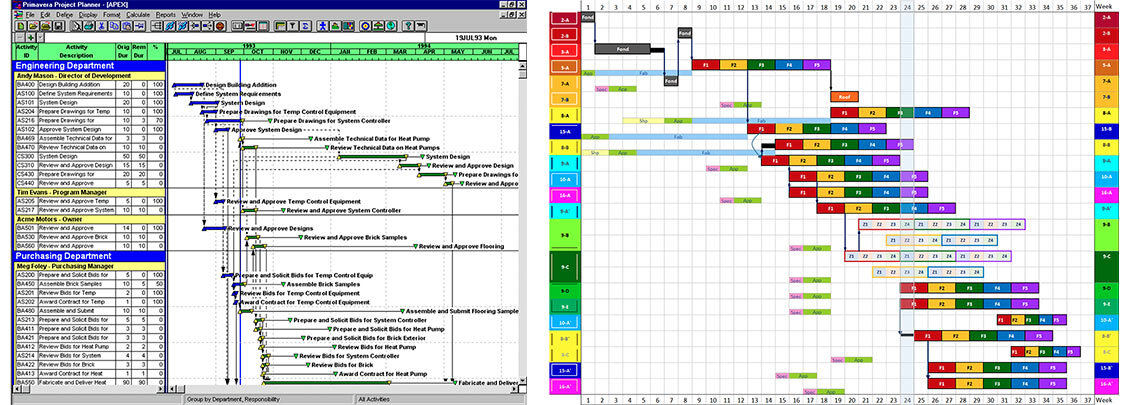
Visual comparison: On the left, a Gantt chart; on the right, a chronographical interface
Worse still, it can generate counter-intuitive anomalies, such as the "Reverse Critical Path," where accelerating a critical task can paradoxically delay the entire project, or vice versa. The schedule thus becomes a sort of "Black Box": an administrative tool useful for communicating with the client, but disconnected from the actual management of the site.
Reversing the Logic: From Activities to Operations
Faced with these limitations, Adel Francis proposes a paradigm shift. Rather than planning activities and then assigning resources to them, he suggests reversing the logic: plan resources and spaces first, then associate operations with them.
This approach is based on a simple but powerful idea: it is the resources (teams, equipment) and spaces (site zones) that truly structure the progress of a project and dictate its duration.
Take the example of a subcontractor. Their primary goal is not to "complete activities," but to keep their teams in continuous production. They seek to avoid downtime and optimize the utilization of their workforce. They plan based on their available resources, not the other way around.
Similarly, materials must arrive at the right time: too early, and they clutter the site, reducing the space available for operations; too late, and they bring teams to a standstill. These dynamics largely escape the Gantt chart.

ÉTS Professor Adel Francis
Making Complexity Visible
One of the major contributions of Adel Francis’s work is the introduction of visual intelligence into construction planning.
Rather than representing the project in the form of lists and tables, his models translate data into intuitive graphics. They allow for the visualization, at a single glance, of space occupancy, the distribution of teams over time, or even zones of congestion.
These models offer several views of the same reality:
- A spatial view of work zones;
- A temporal view of resource utilization;
- A combined view of material and team flows.
This representation makes potential conflicts (for example, two teams assigned to the same space at the same time) immediately visible, even before they occur on the site.
From Critical Path to Critical Space
In this new approach, the traditional concept of the "critical path" loses its relevance. It is replaced by two complementary notions:
- Critical Space: When the main constraint is linked to the availability or saturation of zones;
- Critical Resource: When it is the teams or equipment that limit progress.
The duration of a project is therefore no longer calculated solely based on activities, but based on the balance between these two dimensions. Optimizing a site then becomes a matter of linearizing the use of resources and spaces: avoiding both periods of inactivity and situations of overload. A high-performing site is a fluid site, where teams follow one another without interruption and where spaces are used to their maximum capacity, without conflict.
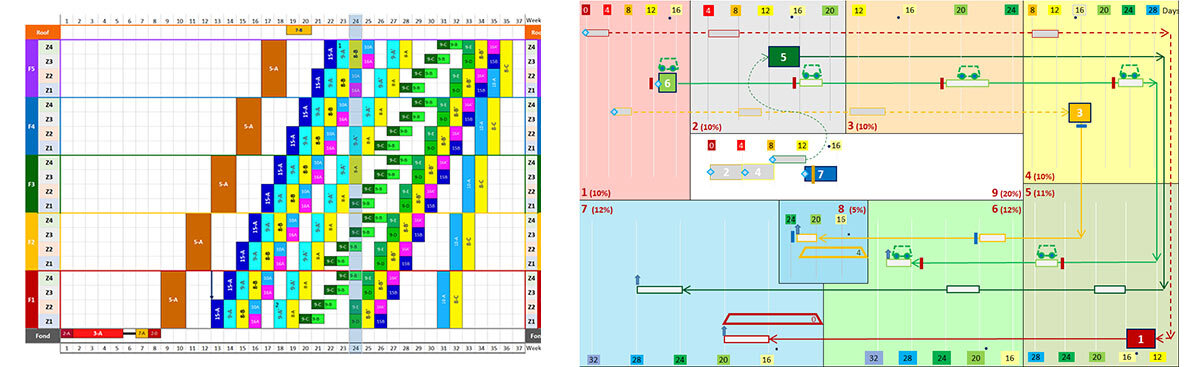
Zoom on the linearization of operations
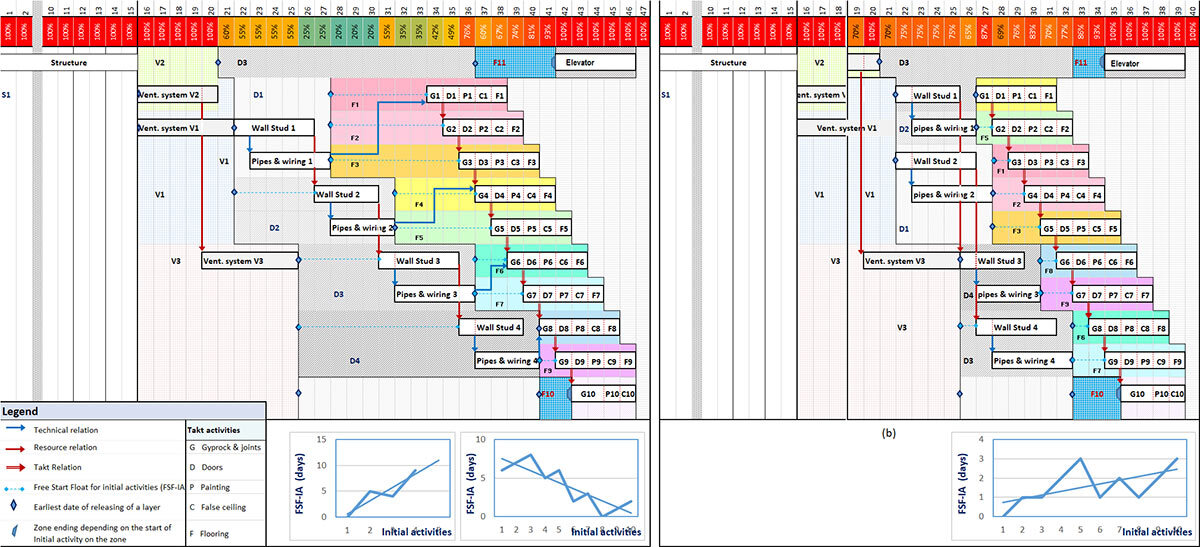
Maximizing space utilization
Toward a More Human Construction 4.0
Beyond technical optimization, this work is part of a broader transformation of the industry: Construction 4.0.
It acts as a bridge between Building Information Modeling (BIM) and the actual execution on the site. Most importantly, it offers an essential interface for the integration of artificial intelligence.
The benefits are concrete:
- Reduction of delays through the early identification of bottlenecks;
- Improved collaboration between general contractors and subcontractors around a shared vision;
- Decrease in waste, in line with the principles of Lean Construction.
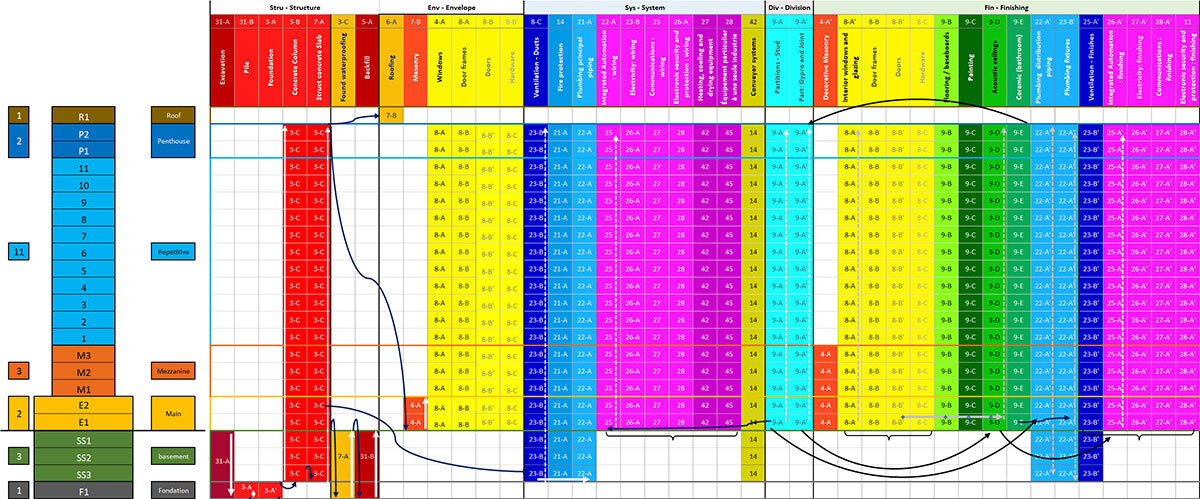
Visual user interface
Seeing to Build Better
By questioning a tool as deeply entrenched as the Gantt chart, Adel Francis is not simply proposing a technical improvement. He is inviting a profound rethinking of how building construction projects are conceived and managed.
His approach rests on a simple idea: you can only optimize what you can see.
By making the interactions between spaces, resources, and operations visible, visual intelligence transforms planning into a true tool for anticipation. And, perhaps, a decisive lever for building more effectively in a world where projects are becoming increasingly complex.